
Germany’s dual vocational training system, known as Ausbildung, is a world-class pathway to a secure and rewarding career. Combining hands-on training in a company with theoretical knowledge in a vocational school, it’s a program designed to create highly skilled professionals. For school leavers, career changers, and international applicants, an Ausbildung offers a unique blend of “earning while learning” and excellent job prospects.
Ausbildung Courses in Germany offer a unique opportunity for international students to gain practical skills while earning a monthly stipend in one of the world’s strongest economies.
Key Highlights: Ausbildung Courses in Germany
- What is Ausbildung?
- Types of Ausbildung Programs
- Top Ausbildung Courses in Germany
- The 2026 Legal Updates: What has Changed?
- Duration of Ausbildung Programs
- What Is the Monthly Stipend for Ausbildung Students?
- What Is the Salary After Completing Ausbildung in Germany?
- What Qualifications Are Needed for Ausbildung Courses?
- What Documents Are Required for Ausbildung in Germany?
- How to Apply for an Ausbildung Visa in Germany Step-by-Step?
- How Much Money Do You Need Monthly in Germany?
- What Insurance Is Included in Ausbildung in Germany?
- Comparative Analysis: Ausbildung vs. University Degrees
- Is It Difficult to Study and Work in Germany as an Ausbildung Student?
- Which Are the Best Cities in Germany for Ausbildung?
- Conclusion
- FAQs
What is Ausbildung?
The Ausbildung is a unique “dual” vocational training system. Unlike a traditional university degree which is 90% theoretical, an Ausbildung is a 50/50 split between a vocational school (Berufsschule) and a training company (Ausbildungsbetrieb). It is designed to equip students with industry-specific skills required for various professions.
Key Benefits
- Duration: 2 to 3.5 years
- Monthly salary: €800 – €1300
- 300+ recognized vocational courses
- High job placement rate after completion
This dual system ensures that students are job-ready from day one, making them highly employable in the German job market.
Types of Ausbildung Programs
Ausbildung Courses in Germany are broadly divided into dual training programs and school-based programs, each catering to different career paths.
| Type | Description | Example Fields |
| Dual Ausbildung | Combination of work and study (most popular) | IT, Engineering, Business |
| School-based Ausbildung | Mainly classroom-based with internships | Nursing, Healthcare, Social Work |
1. Duale Ausbildung (Dual Vocational Training)
This is the standard model for most professions, from trades to business and IT. The trainee has a contract with a company and attends vocational school part-time.
- Examples: Industrial Clerk (Industriekaufmann/-frau), IT Specialist (Fachinformatiker), Automotive Mechatronics Technician (Kfz-Mechatroniker) .
- Compensation: You receive a salary from the company, which covers your living costs
2. Schulische Ausbildung (School-Based Training)
This takes place full-time at a vocational school. It is common for professions in healthcare, social work, and technology. These programs often include integrated internships to provide practical experience.
- Examples: Nursing Specialist (Pflegefachkraft), Physical Therapist (Physiotherapeut), Technical Assistant (e.g., Chemical Laboratory Assistant).
- Compensation: School-based trainings are often unpaid, and you may even need to pay tuition fees, although state funding (BAföG) might be available. However, the official portal “Make it in Germany” notes that your monthly living costs must be secured, for instance via a blocked account.
The dual Ausbildung is the most preferred option among international students because it offers a salary during training.
Top Ausbildung Programs in Germany
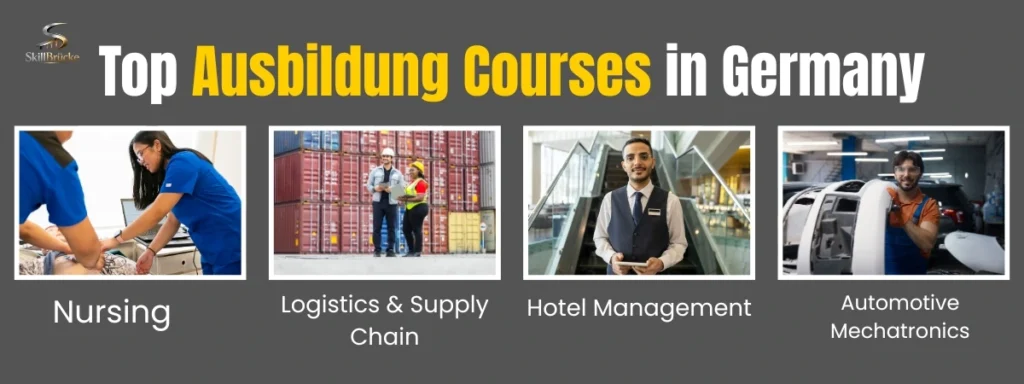
The German labor market is prioritizing “shortage occupations.” We have categorized the following courses as high-value based on their 90%+ job placement rates and the availability of training contracts for international candidates.
| Course Name | Duration | Stipend Range (€/month) | Demand Level |
| Nursing (Pflegefachmann) | 3 Years | €1,100 – €1,200 | Very High |
| IT Specialist | 3 Years | €950 – €1,200 | Very High |
| Renewable Energy Technician | 3.5 Years | €900 – €1,150 | Very High (Green Job) |
| Automotive Mechatronics | 3.5 Years | €900 – €1,150 | Very High |
| Industrial Mechanic | 3 Years | €950 – €1,150 | High |
| Logistics & Supply Chain | 3 Years | €850 – €1,100 | High |
| Hotel Management | 3 Years | €800 – €1,100 | High |
| Chef / Culinary Arts | 3 Years | €800 – €1,100 | High |
| Office Management | 3 Years | €800 – €1,050 | Medium |
| Dental Assistant | 3 Years | €800 – €1,000 | Medium |
| Retail Salesperson | 2 – 3 Years | €800 – €1,000 | Medium |
Healthcare and IT represent the highest strategic value in 2026. Germany’s aging population ensures that skilled nurses are frequently offered full-time contracts before their training even ends. Similarly, the rapid digital transformation of the Mittelstand (SME sector) has made IT specialists indispensable. We also highlight the rise of “Green Jobs,” such as Renewable Energy Technicians, as a premier choice for 2026 applicants.
The 2026 Legal Updates: What has Changed?
Recent policy changes have made Ausbildung Courses in Germany more accessible for international students through faster visa processing and flexible work options. If you are applying this year, you must be aware of these three critical changes:
- Work and Stay Agency (WSA): A new centralized portal launched in late 2025/early 2026 to speed up visa processing for vocational trainees.
- Increased Work Hours: Trainees can now work up to 20 hours per week in a side job (Minijob) to earn extra cash (up to €603/month tax-free).
- Opportunity Card (Chancenkarte): If you don’t have a contract yet, you can enter Germany on this points-based visa to find an Ausbildung position locally.
Duration of Ausbildung Programs
The duration of an Ausbildung reflects the complexity of the professional skill set. While the standard is 3 years, high-precision roles like Automotive Mechatronics or Renewable Energy Technician often require 3.5 years to ensure mastery of complex engineering systems.
Candidates should be aware that previous professional experience or exceptional academic performance during the first year of training can allow for the shortening of the program. This is determined on an individual basis by the employer and the relevant Chamber of Commerce (IHK/HWK). An Ausbildung program in Germany is a great option for students who want practical learning along with a steady income.
What Is the Monthly Stipend for Ausbildung Students?
The primary advantage of the Ausbildung system is achieving financial independence without incurring student debt. Students receive a progressive monthly stipend that increases each year as their skills develop.
Average Progressive Stipend (All Industries)
| Training Year | Average Monthly Stipend |
| 1st Year | €800 – €1,000 |
| 2nd Year | €900 – €1,100 |
| 3rd Year | €1,000 – €1,200 |
Industry-Wise Stipend Comparison
| Industry | Entry Stipend (Year 1) | Growth Potential |
| Healthcare | €1,100 | Highest entry point |
| Manufacturing/Tech | €950 | High technical progression |
| Hospitality | €800 | Often includes perks (meals/housing) |
What Is the Salary After Completing Ausbildung in Germany?
Graduates of Ausbildung Courses in Germany often secure well-paying jobs immediately after completing their training. The “Return on Investment” for vocational training is highly competitive. Upon graduation, specialized Ausbildung holders often earn starting salaries that rival junior university graduates. With an Ausbildung program in Germany, you don’t just study—you build a career from the very beginning.
Post-Graduation Salary Outcomes
Exchange Rate used for reference: ₹90 per €1 (Approximate as of early 2026).
| Sector | Monthly Salary (€) | INR Equivalent (Approx.) |
| IT & Engineering | €2,800 – €3,500 | ₹2,52,000 – ₹3,15,000 |
| Healthcare & Nursing | €2,500 – €3,200 | ₹2,25,000 – ₹2,88,000 |
| Automotive/Manufacturing | €2,400 – €3,000 | ₹2,16,000 – ₹2,70,000 |
| Commerce & Retail | €2,000 – €2,600 | ₹1,80,000 – ₹2,34,000 |
| Hotel & Tourism | €2,000 – €2,800 | ₹1,80,000 – ₹2,52,000 |
What Qualifications Are Needed for Ausbildung Courses?
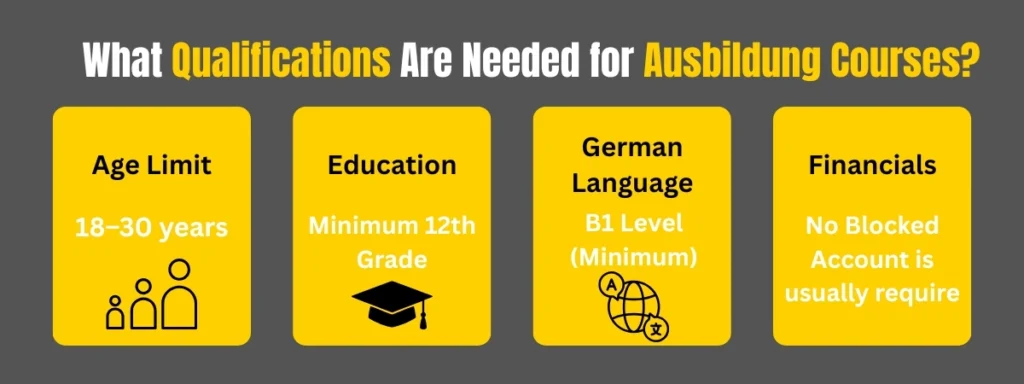
The German government has relaxed several entry barriers to attract talent from India, Asia, and South America. The German government maintains strict standards to preserve the quality of its workforce. Candidates must meet four primary eligibility pillars:
| Requirement | Details |
| Age Limit | Generally 18–30 years (Flexible up to 35 for nursing/IT). |
| Education | Minimum 12th Grade (10+2). 10th grade is accepted for some crafts. |
| German Language | B1 Level (Minimum) for most; B2 Level for Healthcare/IT. |
| Financials | No Blocked Account is usually required if your stipend is above €992/month. |
| Visa Type | Section 16a AufenthG (Vocational Training Visa). |
| Soft Skills | Technical aptitude, reliability, and the ability to adapt to a highly structured German workplace. |
What Documents Are Required for Ausbildung in Germany?
In the German corporate environment, the presentation of your dossier is as important as your qualifications. International candidates must adhere to specific formatting standards to be taken seriously.
The “German Standard” Checklist:
- Tabular Lebenslauf (CV): A clear, chronological CV in the German format, preferably including a professional application photo.
- Statement of Purpose (SOP): A motivation letter clearly explaining your interest in the specific trade.
- Translated Certificates: All educational transcripts must be officially translated into German.
- Language Certificates: Proof of proficiency from a recognized body (Goethe/ÖSD/Telc).
- Valid Passport: Must have at least 12 months of validity.
How to Apply for an Ausbildung Visa in Germany Step-by-Step?
An Ausbildung program in Germany provides a structured and reliable pathway for students aiming for job security and growth. The legal framework for vocational training is the National (D) Visa. The process follows a strict progression:
- Training Contract: You cannot apply for a visa without a signed contract from a German employer.
- Financial Proof: Applicants must demonstrate they can cover their living expenses. However, if your Ausbildung stipend meets the threshold required by current migration laws, the requirement for a “blocked account” is typically waived.
- Health Insurance: Proof of valid health insurance for the entire stay is mandatory.
- Consular Interview: An interview at the German embassy/consulate is required. Processing timelines generally range from 8 to 12 weeks.
How Much Money Do You Need Monthly in Germany? Budgeting for International Students
While Ausbildung Courses in Germany provide a stipend, students should still plan their monthly budget carefully to manage living expenses.
Average Monthly Expenses
| Category | Estimated Cost (€) |
| Rent (Warm-Miete/Utilities) | €300 – €600 |
| Food & Groceries | €150 – €250 |
| Transportation | €30 – €100 |
| Miscellaneous | €100 – €150 |
What Insurance Is Included in Ausbildung in Germany?
Once you start your Ausbildung, you are part of the German Social System. This is often confusing for international students.
- Pension Insurance (Rentenversicherung): 9.3% of your gross pay.
- Health Insurance (Krankenversicherung): 7.3% (plus a small supplement).
- Unemployment Insurance: Ensures that if you lose your job after training, you get 60% of your salary.
- Nursing Care Insurance: Covers long-term care needs.
Comparative Analysis: Ausbildung vs. University Degrees
Selecting the correct path depends on your career focus and financial flexibility.
| Feature | Ausbildung | University Degree |
| Cost | Free; paid monthly stipend. | Low (public) to high (private) tuition. |
| Focus | Practical & Hands-on. | Theoretical & Academic. |
| Earnings | Guaranteed from Day 1. | Generally none during study. |
| Duration | 2 to 3.5 Years. | 3 to 5 Years (Bachelors/Masters). |
| Job Entry | Immediate; industry-integrated. | Requires entry-level internship phase. |
Is It Difficult to Study and Work in Germany as an Ausbildung Student?
Although rewarding, Ausbildung Courses in Germany can be challenging due to language requirements and cultural adaptation. Success in Germany requires mental and cultural preparation. We advise candidates to be mindful of:
- The Language Barrier: Daily operations and vocational school are conducted entirely in German. B1 is a minimum, but it is often insufficient for technical academic success.
- Cultural Integration: Adapting to German work ethics and the Feierabend (work-life separation) culture requires time.
- Financial Management: In expensive cities like Munich or Hamburg, the first-year stipend can be tight.
- Mitigation: We strongly advise reaching B2 German before arrival to significantly improve both your social integration and academic performance.
Which Are the Best Cities in Germany for Ausbildung?
Germany’s 16 states (Bundesländer) offer different economic benefits.
| Region | Key Industries | Cost of Living | Pro Tip |
| Bavaria (Munich) | Automotive, Aero, Tech | Very High | Highest stipends, but housing is scarce. |
| Saxony (Leipzig/Dresden) | Microchips, Logistics | Low | Great for students; “Silicon Saxony.” |
| NRW (Dortmund/Essen) | Healthcare, Industry | Medium | Dense population, many training spots. |
| Baden-Württemberg | Mechanical Engineering | High | Home to Bosch, Porsche, Mercedes. |
Conclusion
Ausbildung in Germany is undoubtedly one of the best opportunities for international students. With Germany actively seeking skilled workers, the demand for Ausbildung candidates is only expected to grow.
For students who want to build a successful career abroad without the burden of heavy tuition fees, Ausbildung serves as a perfect pathway. It not only provides valuable work experience but also opens doors to long-term settlement in Germany.
If you are serious about building a global career, now is the right time to explore Ausbildung courses in Germany and take the first step toward a bright and secure future.
FAQs
Is there a strict age limit for Ausbildung in Germany?
Legally, there is no official upper age limit. However, in practice, most training companies prefer candidates between 18 and 30.
1. 18-25: The “ideal” bracket with the highest visa approval rates.
2. 26-35: Still very common in shortage sectors like Nursing, IT, and Logistics, provided you can explain your career change in your Motivation Letter.
3. 35+: Possible, but requires a very strong profile and a compelling reason for the career pivot to satisfy visa officers.
Do I really need B1 German, or is A2 enough for Ausbildung Courses in Germany?
While the 2026 regulations allow for A2 level entry in specific “Shortage Occupations” (if the employer provides a language commitment), B1 is still the “Safe Standard.” Vocational school exams and technical textbooks are entirely in German. Without B1, you will struggle to pass the theoretical part of the course, which could lead to your contract being terminated. For healthcare, B2 is often mandatory.
Is a “Blocked Account” required for the Ausbildung visa?
Not always. In 2026, the German government requires proof of approx. €992 per month to cover living costs.
If your stipend is ≥ €992/month: You do not need a blocked account.
If your stipend is < €992/month: You must put the “gap” amount into a blocked account. For example, if you earn €800, you must show a blocked account with roughly €192 for each month of the first year.
What happens if I fail my final exams in Ausbildung?
You are usually allowed to repeat the exam twice. If you fail, your training contract is often extended by six months to give you time to study and re-take the test. Your stipend continues during this extension.
Can I do an Ausbildung in English?
No. While some international companies might speak English in the office, the Berufsschule (Vocational School) exams, curriculum, and state certifications are conducted strictly in German.
Suggested Post
Best Ausbildung Consultant in Gurugram