Germany has emerged as one of the most preferred destinations for Indian students looking for affordable international education, global career exposure, and long-term settlement opportunities. While traditional university programs remain popular, the demand for Ausbildung in Germany for Indian students has increased significantly over the last few years. The biggest reason behind this growing trend is Germany’s severe skilled worker shortage. According to recent German labor market reports, the country continues to face shortages in healthcare, nursing, logistics, hospitality, automotive, mechatronics, and technical industries. To solve this issue, Germany is actively welcoming international trainees through the Ausbildung system. One of the biggest advantages is that students receive a monthly stipend during the training itself. In many sectors such as nursing and healthcare, the stipend can reach €1,300–€1,500 per month by the final year.
This detailed topic explains everything about Germany Ausbildung Requirements for Indian Students in 2026 including eligibility, language requirements, visa process, documents, salary, top courses, PR opportunities, and much more.
Key Highlights: Germany Ausbildung Requirements for Indian
- What is Germany Ausbildung? (The Basics Explained)
- Choosing Your Path: Working for a Company vs. Studying at a College
- Who Can Apply? (School Marks, Age Limits, and Qualifications Needed)
- The German Language Rule (What Level Do You Realistically Need?)
- Money, Salaries, and Whether You Need a Blocked Account
- The Best Job Sectors for Indians (Stipends and Future Salaries Compared)
- Sector-Wise Breakdown: Stipends, Demands, and Outcomes
- Budgeting and Cost of Living Model
- The Step-by-Step Application Roadmap from India
- How to Apply for Your Ausbildung Visa (Document Checklist)
- Life After Ausbildung: Work, PR, and Settlement
- Conclusion
- FAQs
What is Germany Ausbildung? (The Basics Explained)
An Ausbildung is a formal, state-regulated vocational training programme that transforms an individual into a highly skilled, specialized professional over a period of 2 to 3.5 years. Unlike typical apprenticeships in other parts of the world, which are often unstructured, the German Ausbildung is highly systematized and governed by strict federal laws under the Vocational Training Act (Berufsbildungsgesetz – BBiG).
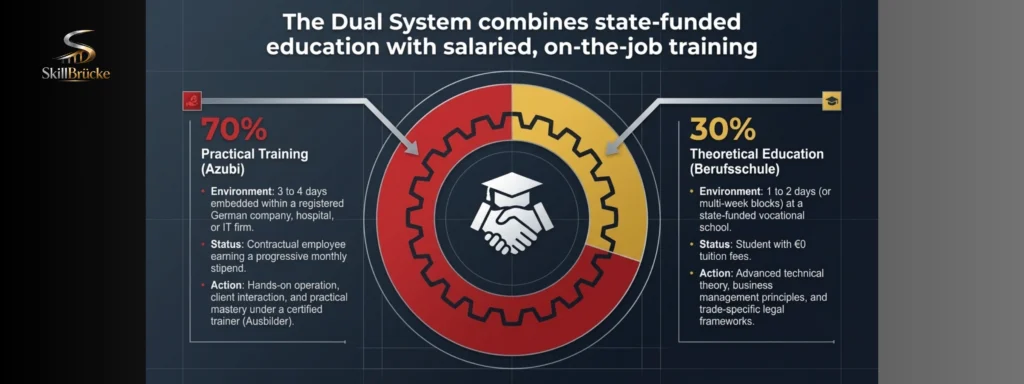
The programme operates on a strict Dual System Split:
- Practical Training (70% of the curriculum): The trainee (Azubi) spends 3 to 4 days a week embedded within a registered German company, hospital, hotel, or IT firm. Here, they operate as a contractual employee, learning on-the-job mechanics, operating machinery, interacting with clients, or managing patient care under the direct supervision of a certified trainer (Ausbilder).
- Theoretical Education (30% of the curriculum): For the remaining 1 to 2 days a week (or in consolidated multi-week blocks known as Blockunterricht), the trainee attends a state-funded vocational school (Berufsschule). The curriculum covers advanced technical theory specific to the trade, business management principles, legal frameworks, and specialized German language skills.
Choosing Your Path: Working for a Company vs. Studying at a College
When researching the Germany Ausbildung Requirements for Indian applicants, you must understand that there are two distinct types of vocational paths available. While the dual system is the most prevalent route for international applicants, it is important to distinguish it from its counterpart:
- Dual Ausbildung (Company-Based): You sign a contract directly with an employer. The employer pays you a mandatory monthly stipend from day one, covers your practical training costs, and your tuition at the state vocational school is completely free (€0). This is the primary pathway utilized by Indian candidates.
- School-Based Ausbildung (Schulische Ausbildung): This format is common in fields like healthcare support, design, cosmetics, and social work. The training takes place primarily within a private or public specialized college, supplemented by internship periods. Crucially, school-based programmes often do not pay a monthly stipend and may occasionally charge tuition fees, requiring candidates to fully fund their stay via a traditional blocked account.
Who Can Apply? (School Marks, Age Limits, and Qualifications Needed)
Securing an Ausbildung position from India requires meeting explicit structural, academic, and administrative legal bars. German employers do not judge applications purely on competitive entrance exams like JEE or NEET; instead, they prioritize foundational school-leaving certificates, practical aptitude, and legal compliance.
- Academic Level: 12th Pass preferred (10th + ITI accepted)
- Certificate Status: Recognized Board + Official Translation
- Age Alignment: Ideally 18-28 years (Flexible up to 35)
- Language Badge: Confirmed B1/B2 Goethe, TELC, or ÖSD Certificate
- Medical Status: Certified fit for trade-specific demands
- Character Record: Clean Indian Police Clearance Certificate
Academic Qualifications & The Recognition Process
The baseline legal requirement to enter a qualified vocational training programme in Germany is a school-leaving certificate equivalent to the German Hauptschulabschluss (completion of 9th grade) or Realschulabschluss (completion of 10th grade). However, in practical recruitment scenarios for non-EU applicants, the expectations are higher:
- Class 12th Graduation (Senior Secondary Certificate): This is the gold standard for Indian candidates. Completion of Class 12 from recognized central boards (CBSE, ICSE) or any official State Board is highly favored by German employers. It equates comfortably to the German Mittlere Reife or Abitur contextually for vocational filters.
- Class 10th Graduation + 2-Year ITI Diploma / Polytechnic Diploma: If an applicant completed Class 10 and followed it with a structured 2-year Industrial Training Institute (ITI) or polytechnic course in trades like electrical, mechanical, or automotive systems, they possess a competitive profile. This technical baseline proves hands-on capability, which appeals directly to industrial employers like Siemens, BMW, or local Mittelstand engineering firms.
- General Degree Holders: Applicants holding Indian bachelor’s degrees (B.Com, B.Sc, B.A.) who wish to pivot into high-paying German technical trades or healthcare are eligible, provided they are under the preferred age ceiling.
Getting Your Indian School Certificates Recognized in Germany – Zeugnisanerkennung
Your Indian certificates cannot simply be mailed in their raw format to a German employer. They must undergo an official evaluation process to verify their German equivalence.
- The Anabin Database: Managed by the Central Office for Foreign Education (Zentralstelle für ausländisches Bildungswesen – ZAB), this portal marks Indian boards with specific status codes.
- State-Level Recognition (Anerkennungsstellen): Depending on the German federal state (Bundesland) where your employer is located, you may need to submit your translated transcripts to the state’s specific certificate recognition office to receive a formal Anerkennungsbescheid (Equivalence Decree).
- Translation Requirements: All Indian transcripts, degree certificates, and school-leaving documents must be translated into German by a sworn, court-certified translator (vereidigter Übersetzer). English-medium certificates are occasionally reviewed by employers, but official German translations are mandatory for visa issuance.
Age Limitations and Profiles
From a strictly legal standpoint, the German Federal Residence Act does not mandate a hard, inflexible maximum age cap for a vocational training visa. However, the operational Germany Ausbildung Requirements for Indian trainees reveal specific age preferences among corporate recruiters:
- The Optimum Bracket (18 to 25 Years): This is the highly preferred age window for almost all technical, hospitality, commercial, and logistical trades. German companies structurally optimize their internal mentoring around young adults entering the workforce.
- The Extended Window (26 to 30 Years): Completely viable, particularly for sectors experiencing critical labor deficits, such as Healthcare/Nursing, IT Specialists, and Renewable Energy Technicians. Candidates in this bracket must write a highly compelling Motivation Letter (Anschreiben) explaining their career pivot.
- The Upper Limit (31 to 35 Years): Visas and contracts are still granted in this bracket, but almost exclusively for specialized healthcare sectors, senior care (Altenpflege), or niche technical roles where the applicant has previous relevant work experience in India. Beyond 35, visa approvals for entry-level Ausbildung are exceptionally rare.
Physical and Health Clearances
Certain professions – specifically healthcare, culinary arts, electrical engineering, and heavy logistics – require proof of physical stability and immunization.
- Medical Fitness Certificate: Applicants must provide a signed declaration from a registered medical practitioner confirming they are free of communicable diseases and possess the physical stamina, structural mobility, and color-vision acuity (crucial for electricians and mechatronics engineers) required to execute the trade.
- Immunization Mandates: For nursing and medical assistant roles, strict proof of up-to-date vaccinations (including Measles, Hepatitis B, and standard European health compliance panels) is legally required before setting foot in a German clinical facility.
The German Language Rule (What Level Do You Realistically Need?)
Mastering this skill is the most critical part of the Germany Ausbildung Requirements for Indian applicants. The single most frequent reason for Ausbildung application rejections and visa denials for Indian candidates is a lack of German language proficiency.
Crucial Reality Check: An Ausbildung is taught entirely in the German language. Your supervisors at work will speak German, your vocational school exams will be written in technical German, and your safety manuals are written in German. There is no such thing as an English-medium Ausbildung.
CEFR LANGUAGE BENCHMARK MATRIX
| A1 -> A2 Foundational Grammar | B1Baseline Requirement | B2The Professional Standard |
| – Everyday phrases- Basic vocabulary- Not visa eligible | – General conversation- Simple presentations- Min. legal visa bar | – Technical terminology- Complex problem solving- Mandatory for Healthcare/IT |
Globally Recognized Testing Bodies
German immigration authorities and Chambers of Commerce (IHK / HWK) recognize language certifications from a specific, secure list of testing institutes. Certificates from unverified private coaching centers will result in immediate visa rejection. You must clear exams from one of the following providers:
- Goethe-Institut: The gold standard worldwide. The Goethe-Zertifikat (B1 or B2) is universally trusted by every consulate and employer in Germany.
- TELC (The European Language Certificates): Widely administered across Europe and through premium certified partner hubs in India.
- ÖSD (Österreichisches Sprachdiplom Deutsch): The official Austrian German language diploma, fully accepted and equivalent to Goethe standards under visa regulations.
Sector-Specific Language Demands
| Ausbildung Trade | Minimum Visa Requirement | Recommended Employer Level | Technical Language Target |
| Nursing / Healthcare | B1 | B2 | Medical terminology, patient documentation, and anatomical vocabulary |
| IT Specialist | B1 | B1+ / B2 | Software syntax logic, client consulting vocabulary, system documentation |
| Automotive Mechatronics | B1 | B1 | Mechanical schematics, tool identification, diagnostics reporting |
| Hotel / Hospitality | B1 | B1 | Guest relations rhetoric, culinary inventory terminology, billing systems |
Money, Salaries, and Whether You Need a Blocked Account
One of the most attractive aspects of the dual Ausbildung system is that it minimizes the need for upfront capital. However, German immigration law is clear: Every foreigner residing in the Federal Republic must prove they can secure their livelihood without relying on German public social welfare. Navigating these financial rules is an essential part of understanding the Germany Ausbildung Requirements for Indian students
The Livelihood Thresholds
German immigration authorities adjust the minimum monthly livelihood requirement based on inflation and cost-of-living matrices.
- The absolute minimum baseline required to sustain a single individual undergoing vocational training is €959 net per month (or approximately €1,048 gross per month before statutory social security deductions).
- If your signed Ausbildungsvertrag (Training Contract) stipulates that your employer is paying you a monthly stipend equal to or higher than this threshold, your livelihood is considered legally secure. In this case, you are completely exempt from opening a Blocked Account (Sperrkonto).
The Blocked Account (Sperrkonto) Deficit Protocol
If your chosen trade pays a starting stipend that falls below the legal line – for example, a hospitality position paying €850 gross per month – you must make up the difference to secure visa approval.
You can bridge this financial gap through two primary mechanisms:
- A Partial Blocked Account: You calculate the exact monthly deficit, multiply it by 12 months, and deposit that specific sum into a certified German bank account (such as Fintiba, Expatrio, or Coracle) prior to your visa appointment. For instance, a monthly gap of €198 requires a total blocked deposit of €2,376 for your first year.
- Verpflichtungserklärung (Formal Declaration of Commitment): A document signed by a relative or sponsor permanently residing inside Germany who possesses sufficient certified income. They legally pledge to the local Foreigners’ Authority (Ausländerbehörde) that they will cover any financial liabilities or living expenses you incur.
The Best Job Sectors for Indians (Stipends and Future Salaries Compared)
The German labor market is experiencing acute shortages in specific clusters. Targeting these sectors significantly increases your chances of contract placement.
Sector Demand & Key Roles
Reviewing these figures helps you plan for the financial Germany Ausbildung Requirements for Indian applicants
| Sector | Key Role | Growth Potential | Vacancy Est. |
| Healthcare | Nurse, Geriatric Care, Lab Tech | Permanent High | 85,000+ |
| Hospitality | Hotel Manager, Chef, Event Planner | High / Seasonal | 80,000+ |
| Tech & IT | System Integrator, App Developer | Rapid Evolution | 25,000+ |
| Engineering | Mechatronics, Automotive Tech | Stable / Technical | 18,000+ |
| Logistics | Warehouse Specialist, Supply Chain | Rapid Growth | 15,000+ |
Sector-Wise Breakdown: Stipends, Demands, and Outcomes
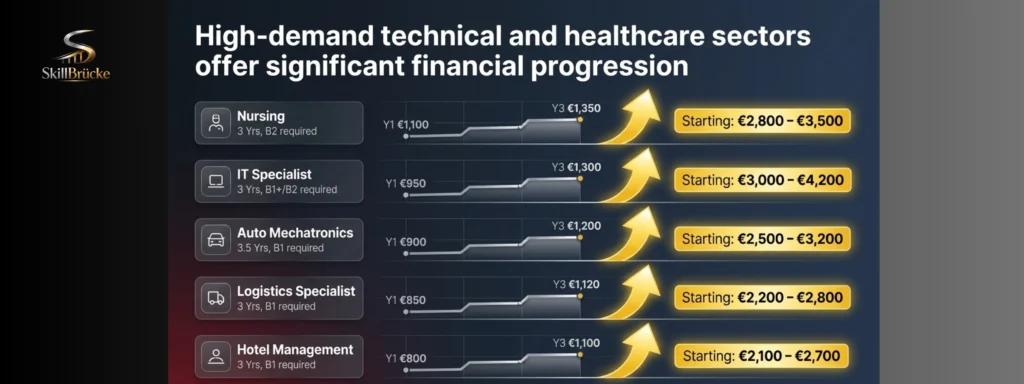
Not all Ausbildung paths are created equal. Stipends vary significantly based on your chosen sector, the regional location of your employer, and the binding collective bargaining agreements (Tarifverträge) in place
The tables below outline the leading Ausbildung opportunities for Indian applicants, detailing progressive stipends, language standards, and entry-level career outcomes.
High-Paying and High-Demand Technical and Healthcare Sectors
| Sector & German Title | Duration | Year 1 Stipend (Gross) | Year 2 Stipend (Gross) | Year 3 Stipend (Gross) | Min. German Level | Starting Post-Ausbildung Gross Salary (Monthly) |
| Nursing | 3 Years | €1,100 – €1,150 | €1,150 – €1,250 | €1,250 – €1,350 | B2 | €2,800 – €3,500 |
| IT Specialist | 3 Years | €950 – €1,050 | €1,050 – €1,150 | €1,150 – €1,300 | B1+ / B2 | €3,000 – €4,200 |
| Automotive Mechatronics | 3.5 Years | €900 – €1,000 | €950 – €1,080 | €1,050 – €1,200 | B1 | €2,500 – €3,200 |
| Electronics Technician | 3.5 Years | €850 – €980 | €920 – €1,050 | €1,000 – €1,150 | B1 | €2,600 – €3,300 |
| Industrial Mechanic | 3.5 Years | €950 – €1,020 | €1,000 – €1,100 | €1,100 – €1,200 | B1 | €2,700 – €3,400 |
Service, Hospitality, and Logistics Sectors
| Sector & German Title | Duration | Year 1 Stipend (Gross) | Year 2 Stipend (Gross) | Year 3 Stipend (Gross) | Min. German Level | Starting Post-Ausbildung Gross Salary (Monthly) |
| Logistics Specialist | 3 Years | €850 – €950 | €920 – €1,020 | €1,000 – €1,120 | B1 | €2,200 – €2,800 |
| Hotel Management | 3 Years | €800 – €880 | €880 – €980 | €950 – €1,100 | B1 | €2,100 – €2,700 |
| Chef / Culinary Arts | 3 Years | €800 – €900 | €900 – €1,000 | €1,000 – €1,150 | B1 | €2,200 – €2,900 |
| Retail Salesperson | 3 Years | €820 – €920 | €900 – €1,000 | €1,000 – €1,150 | B1 | €2,100 – €2,700 |
Budgeting and Cost of Living Model
While you earn a stipend from day one, managing your personal finances effectively is key to a smooth transition. Living costs in Germany vary considerably between large metropolitan areas (like Munich, Frankfurt, or Hamburg) and smaller towns or rural districts where many industrial firms are located.
Average Monthly Living Cost Analysis
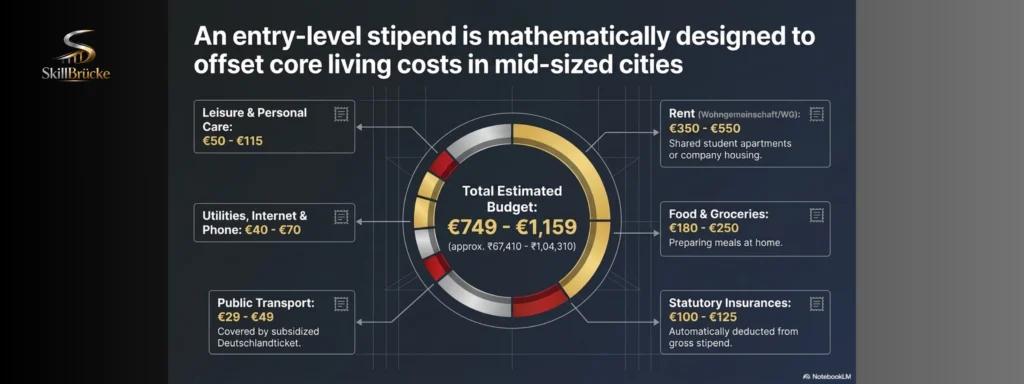
The following table provides an illustrative monthly budget for a first-year trainee based in a mid-sized German city:
| Cost Category | Estimated Monthly Cost (EUR) | Estimated Monthly Cost (INR) | Operational Notes |
| Rent / Accommodation | €350 – €550 | ₹31,500 – ₹49,500 | Shared student apartments (Wohngemeinschaft – WG) or company housing. |
| Food & Groceries | €180 – €250 | ₹16,200 – ₹22,500 | Preparing meals at home significantly reduces daily expenses. |
| Statutory Insurances | €100 – €125 | ₹9,000 – ₹11,250 | Automatically deducted from your gross stipend. |
| Public Transportation | €29 – €49 | ₹2,610 – ₹4,410 | Covered by subsidized local transport options or the Deutschlandticket. |
| Utilities, Internet & Phone | €40 – €70 | ₹3,600 – ₹6,300 | High-speed mobile data and shared home utility bills. |
| Leisure & Personal Care | €50 – €115 | ₹4,500 – ₹10,350 | Gym memberships, social outings, and miscellaneous items. |
| Total Estimated Budget | €749 – €1,159 | ₹67,410 – ₹1,04,310 | Balanced evenly or fully offset by your entry-level monthly stipend. |
The Step-by-Step Application Roadmap from India
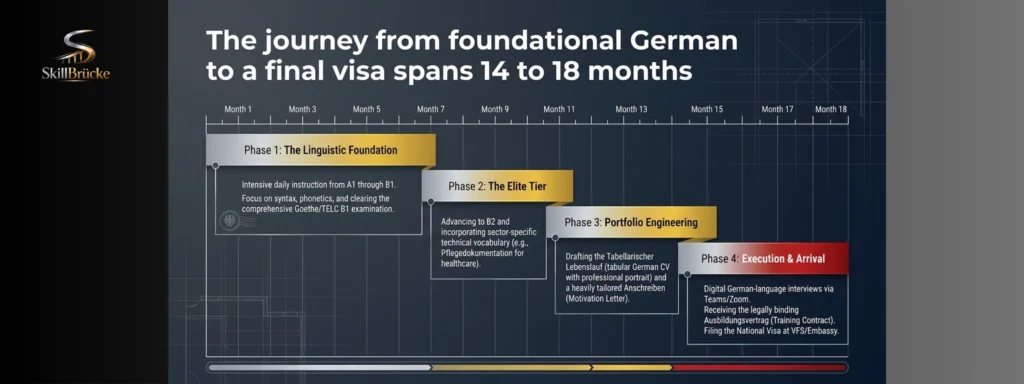
Securing a spot in a foreign vocational program requires strict organization. The transition from your initial German language class in India to your first day of work in Stuttgart or Munich generally spans 14 to 18 months.
Month 1 to 3: The Linguistic Foundation (A1 & A2)
- Enroll in a structured, intensive German language program.
- Focus on phonetics, fundamental syntax structures, sentence configuration, and basic day-to-day conversation patterns.
- Aim for 2 to 3 hours of formal instruction daily, reinforced by audio immersion.
Month 4 to 7: The Intermediate Threshold (B1)
- Advance your vocabulary to encompass general work scenarios, complex past tenses, and relative clauses.
- Register for and sit the Goethe/TELC B1 Examination. Ensure you clear all four modules: Reading, Writing, Listening, and Speaking.
Month 8 to 11: The Elite Tier & Technical Specialization (B2)
- For high-paying or client-facing fields, continue immediately to B2.
- Incorporate sector-specific terms (e.g., Pflegedokumentation for nurses, Steuerungstechnik for mechatronics technicians).
- Clear the official B2 examination to maximize your application’s appeal to employers.
Month 12 to 14: Portfolio Engineering & Direct Applications
- Lebenslauf (The German Resume): Reformat your CV into the standard German Tabellarischer Lebenslauf. This format is strict, chronological, tabular, clear, and typically includes a professional portrait photograph (Bewerbungsfoto) on the upper right corner.
- Anschreiben (The Cover/Motivation Letter): Draft a targeted, 1-page German motivation letter for each role. Clearly explain why you want to train in this specific field, why you chose that particular company, and how your Indian educational background supports your placement.
Month 15 to 18: Digital Interviews, Contractual Security & Visa Finalization
- The Digital Interview (Vorstellungsgespräch): Once an HR manager shortlists your profile, you will undergo a comprehensive video interview (via Microsoft Teams or Zoom). The entire conversation will be conducted in German to evaluate your real-world communication skills, promptness, and cultural readiness.
- Receiving the Ausbildungsvertrag: Upon selection, the company will mail you your legally binding Training Contract. This critical document lists your weekly training hours, your exact progressive monthly stipend across all training years, holiday allocations, and your school integration codes.
- Embassy Navigation: Book an appointment at your regional German Embassy or VFS Global application center (New Delhi, Mumbai, Bangalore, Chennai, or Kolkata) to file your national visa application, ensuring your file perfectly matches the official Germany Ausbildung Requirements for Indian passport holders.
How to Apply for Your Ausbildung Visa (Document Checklist)
To clear the final hurdle and enter Germany, you must navigate the National Visa for Vocational Training (§16a AufenthG) process. This pathway is distinct from a standard tourist or university student visa.
CRITICAL VISA DOSSIER BLUEPRINT
- Legally Executed Ausbildungsvertrag (Signed by Employer)
- Official German School Equivalency Decree (Anerkennung)
- Verified Language Certificate (Goethe/TELC B1/B2 Original)
- Verified Language Certificate (Goethe/TELC B1/B2 Original)
- Comprehensive Health Insurance Portfolio Cover
- Livelihood Compliance Document (Stipend Ledger / Sperrkonto)
- Valid Indian Passport + Certified Biographical Copies
Essential Document Dossier Checklist
When presenting yourself at the consulate or VFS center, your file must be structured with the following documents:
- The Signed Ausbildungsvertrag: The original contract signed by both you and your host company, and stamped by the relevant chamber (e.g., IHK for industrial trades, HWK for craft trades)
- The Berufsschulbestätigung: A document from the vocational school confirming your placement or enrollment in the theoretical class track.
- Proof of Language Proficiency: Your original B1 or B2 Goethe/TELC certificate, issued within the last 12-24 months.
- Proof of School Recognition: Your Anerkennungsbescheid or an official printout from the Anabin database showing your school board’s structural verification.
- Financial Livelihood Proof: Your contract showing a stipend above the legal limit, or confirmation of a blocked account to cover any deficit.
- ZAV Approval (Zustimmung der Bundesagentur für Arbeit): In many instances, the employer secures pre-approval from the Federal Employment Agency’s International Placement Service (ZAV). This confirms that no equally qualified German or EU citizen was available for the position, which significantly accelerates your visa processing time.
- Incoming Travel Health Insurance: A valid temporary international health policy covering your initial 90 days in Europe, which transitions to your permanent statutory health insurance card upon arrival.
Submitting an application with a stipend that falls below the legal limit without providing a supplementary blocked account to cover the deficit will violate the basic financial Germany Ausbildung Requirements for Indian applicants and result in a visa denial
Common Visa Rejection Traps and Mitigation Strategies
- Trap 1: The Communicative Disconnect. If you present a B2 language certificate but struggle to answer basic foundational questions from the visa officer in German during your interview, your application may be flagged for verification or denied.
- Mitigation: Keep practicing your German speaking skills up until your interview date. Do not treat the language exam as a one-time test.
- Trap 2: The Ambiguous Motivation Profile. If your motivation letter reads like a generic template or focuses solely on escaping to Europe rather than mastering the specific trade, the visa officer may flag your application for lack of genuine intent.
- Mitigation: Tailor your motivation letter to your specific field. Reference distinct operational modules of the company and explain how your past studies connect to your future trade.
- Trap 3: Structural Financial Gaps. Submitting an application with a stipend that falls below the legal limit without providing a supplementary blocked account to cover the deficit will result in an immediate administrative denial.
- Mitigation: Double-check your gross monthly stipend against current immigration guidelines before your interview. Set up a partial blocked account if your stipend falls short.
Life After Ausbildung: Work, PR, and Settlement
Completion of the program grants you a state-recognized certificate, essentially a “golden ticket” to the German labor market.
| Stage | Duration / Requirement | Outcome |
| Graduation | Pass IHK/HWK Final Exams | State-certified Professional Title |
| Full-time Work | 2 Years of professional employment | Eligibility for Settlement Permit (PR) |
| Settlement (PR) | B1 German + 3 years of work | Permanent Residency & Freedom of Movement |
| Citizenship | 5 Years (under new 2024 laws) | German Passport |
Completion of your studies and entering the local workforce allows you to successfully transition beyond the initial Germany Ausbildung Requirements for Indian trainees. Post-completion, starting salaries typically jump to €2,500 – €3,500 per month.
Conclusion
This master guide provides a full, transparent breakdown of the Germany Ausbildung Requirements for Indian candidates. In an era of skyrocketing international tuition and job market volatility, Germany offers a path built on financial self-sufficiency, high-demand skills, and a clear legal route to permanent residency.
We encourage you to look beyond the immediate challenge of the language barrier. The reward – a stable, high-paying career in the heart of Europe – is within your grasp if you begin your preparation today. Your journey starts with one word: Anfangen (To begin).
FAQs
Can I do Ausbildung after 12th?
Yes, it is the standard qualification for entry.
What are the Germany Ausbildung requirements for Indian students?
Students usually need:
1. 10th or 12th qualification
2. German language B1
3. Valid passport
4. Ausbildung contract
Is IELTS required?
No. Only German certificates (Goethe/TELC/ÖSD) matter.
Is a blocked account mandatory?
Not if your stipend meets the €939 (in-firm) or €832 (school) threshold.
What if I fail the final exam?
You can typically extend your contract and retake the exam twice.
Related Post
Ausbildung Courses in Germany
Best Ausbilding Consultant in Delhi
Best Ausbilding Consultant in Gurgaon