While many students know Germany for its tuition-free universities, another highly successful education pathway is gaining massive popularity in recent years – Vocational Training Courses in Germany. Known as “Ausbildung” in Germany, vocational training programs combine classroom education with paid practical work experience. These programs are designed to prepare students directly for skilled professions in industries facing workforce shortages. From healthcare and IT to hospitality, automotive engineering, logistics, and mechatronics, Germany offers hundreds of vocational training opportunities with monthly salaries, strong job security, and long-term settlement options.
For Indian students and other international applicants, vocational training in Germany has become an affordable and career-oriented alternative to expensive university degrees. Students not only learn industry-relevant skills but also earn while studying, making Germany one of the few countries where education and employment go hand in hand.
According to updated 2026 labor market estimates, Germany continues to face a shortage of more than 1.9 million skilled workers across various sectors. Due to its aging population and increasing industrial demand, the country is actively welcoming international trainees through vocational education programs. This has opened massive opportunities for students who want practical education, stable income, and a pathway to work and settle in Europe.
Overview of Popular Vocational Training Programs
Germany offers 327 recognised training programs (326 within the dual system)
The following table highlights the most popular choices among trainees:
Major Categories of Vocational Courses
Many international students are now choosing Vocational Training Courses in Germany as a practical and affordable alternative to traditional university degrees. Students can choose programs based on their interests and career goals.
| Technical Courses | Healthcare Courses | IT & Digital Courses | Hospitality & Tourism | Business & Administration |
| MechatronicsAutomotive TechnologyElectrical EngineeringIndustrial Mechanics | NursingElderly CarePhysiotherapyMedical Assistance | Software DevelopmentIT SpecialistSystem IntegrationData Processing | Hotel ManagementCulinary ArtsRestaurant ServicesTourism Management | Office ManagementBankingRetail ManagementLogistics |
| Category | Top Dual Apprenticeship Programs |
| Top 10 Most Frequent | Office Manager, Motor Vehicle Mechatronics Technician, Retail Management/Sales Assistant, IT Specialist, Medical Assistant, Industrial Clerk, Electronics Technician. |
| Skilled Crafts | Carpenter, Painter, Cook, Hairdresser. |
| Gender-Specific Trends | Male Trainees: Automotive Mechatronics, Electronics, IT, Industrial MechanicsFemale Trainees: Office Management, Medical/Dental Assistance, Retail Sales |
Remuneration and Duration by Profession
The “Earn While You Learn” model is a hallmark of German vocational training. Salaries, known as a training allowance, increase each year of the program.
| Training Aspect | Details and Statistics (2022/2026 data) |
| Typical Duration | 2 to 3.5 years |
| Average Salary (Gross) | Approximately €1,028 per month |
| Highest Paying Roles | Carpenter (€1,254), Bricklayer (€1,209) |
| Lowest Paying Roles | Maker of Orthopaedic Footwear (€652), Hairdresser (€657) |
Vocational Training Courses by Industry Sector
Vocational training is available across nearly every sector of the economy. While the dual system is common for most, some fields (like healthcare and social services) frequently offer school-based vocational training
| Industry Sector | Specific Vocational Courses |
| Healthcare & Social Services | Nursing, Physiotherapy, Midwifery, Geriatric Nursing, Pharmaceutical-Technical Assistant, Social Assistant, Occupational Therapy (OT) Assistant, Lab Technician. |
| Technology & IT | IT Specialist, IT Technician, Information Technology Assistant, Electrician, Design Assistant. |
| Business & Services | Hospitality Management, Bank Clerk, Dietician, Sports & Fitness Trainer. |
| Specialised (for Abitur holders) | Industrial Technologist (Data Tech), Business IT Specialist, Air Traffic Controller. |
Top Industries Hiring Vocational Trainees
| Industry | Growth | Demand for Skilled Workers |
| Healthcare | Very High | Critical Shortage |
| Information Technology | Very High | Massive Demand |
| Automotive | High | Strong |
| Logistics | High | Growing |
| Hospitality | Moderate to High | High |
| Manufacturing | High | Stable |
| Renewable Energy | Rapidly Growing | Increasing |
Most Popular and Highest-Paying Vocational Training Courses in Germany
The structural labor shortage in Germany across engineering, healthcare, and digital infrastructure has altered the compensation metrics for vocational training. In 2026, stipends have significantly scaled upward, transforming roles historically categorized as “blue-collar” into some of the fastest routes to an upscale income. Due to severe labor shortages, the stipends for the top Vocational Training Courses in Germany have scaled upward significantly.
The Federal Institute for Vocational Education and Training (BIBB) notes that technical and medical specialties command the highest compensation because of their intensive training requirements and critical workforce value.
| Vocational Profession (German Designation) | Core Sector Focus | Year 1 Stipend (Gross) | Year 2 Stipend (Gross) | Year 3 Stipend (Gross) | Expected Starting Salary (Gross/Month) |
| Nursing Specialist (Pflegefachmann/-frau) | Healthcare & Medical | €1,100 – €1,150 | €1,150 – €1,250 | €1,250 – €1,350 | €3,200 – €3,800 |
| IT Specialist (Fachinformatiker) | Technology & Software | €1,000 – €1,050 | €1,100 – €1,150 | €1,200 – €1,300 | €3,400 – €4,200 |
| Mechatronics Technician (Mechatroniker) | Automotive & Heavy Mfg. | €980 – €1,050 | €1,050 – €1,150 | €1,150 – €1,280 | €3,000 – €3,600 |
| Electronics Technician (Elektroniker) | Renewable Energy & Power | €950 – €1,000 | €1,020 – €1,100 | €1,100 – €1,220 | €2,900 – €3,500 |
| Industrial Mechanic (Industriemechaniker) | Precision Engineering | €960 – €1,020 | €1,020 – €1,120 | €1,120 – €1,250 | €2,800 – €3,400 |
| Logistics & Warehouse Specialist (Fachkraft für Lagerlogistik) | Supply Chain & E-Commerce | €880 – €940 | €940 – €1,020 | €1,020 – €1,120 | €2,400 – €3,000 |
| Hotel Management Specialist (Hotelfachmann/-frau) | Tourism & Hospitality | €800 – €880 | €900 – €980 | €1,000 – €1,100 | €2,200 – €2,800 |
Financial Framework: Salaries, Training Allowances, and Living Costs
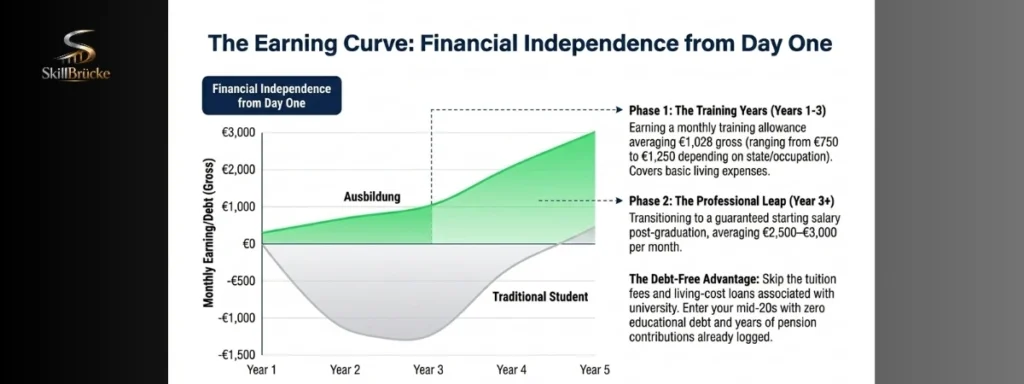
A major benefit of enrolling in Vocational Training Courses in Germany is the legally protected “Earn While You Learn” framework that guarantees a minimum training wage.
- Minimum Training Wage: Introduced in 2020 (currently adjusted to €620+), ensuring no trainee is exploited.
- Gross vs. Net: The training allowance (Ausbildungsvergütung) is a gross figure. Trainees must account for social security and health insurance deductions.
- Self-Sufficiency: In 2026, while allowances are high, they often don’t cover 100% of living costs in cities like Munich. Applicants must often show additional savings for visa purposes.
| Year of Training | Average Monthly Gross (Base) |
| Year 1 | €930 |
| Year 2 | €1,020 |
| Year 3 | €1,100 |
What is Vocational Training in Germany?
The German dual system (duale Berufsausbildung) is a historical pillar of the “Mittelstand” economic model, predicated on a unique synergy between the state, the private sector, and social partners. Its defining characteristic is the pursuit of Handlungskompetenz (Vocational Action Competence) – a pedagogical standard that ensures a graduate can perform tasks effectively, autonomously, and innovatively in a real-world professional environment.
The system mainly operates under two structures:
- Dual Vocational Training (Duale Ausbildung)
This is the most popular vocational training model.
Students spend:
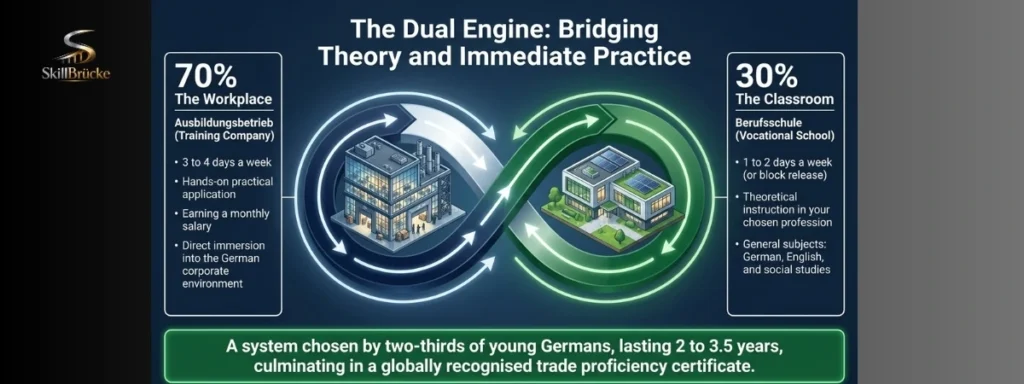
- 3 – 4 days per week working in a company
- 1 – 2 days studying in vocational school
The company pays students a monthly salary while they learn practical skills.
- School-Based Vocational Training
This type is common in:
- Healthcare
- Nursing
- Physiotherapy
- Childcare
- Social services
The dual education system allows participants in Vocational Training Courses in Germany to spend 70% of their time gaining hands-on experience at a company and the rest studying theory at a vocational school. Students attend vocational institutions more frequently, and internships are included during the course.
The Mechanics of the Dual System
The organizational efficiency of the 2026 model relies on a precisely timed split of responsibilities. Trainees spend approximately 70 – 75% of their time at the training company, where they are treated as productive members of the workforce under the guidance of a certified trainer. The remaining 25 – 30% is spent in the vocational school, often delivered in “block lessons”, intensive weeks of theory, or a weekly alternating schedule.
Quality control is enforced through mandatory milestones:
- Interim Examination: A mid-way assessment to ensure the trainee is meeting practical benchmarks.
- Final Examination: Conducted by the relevant Chambers (IHK for industry/commerce; HWK for crafts). These exams are strictly in German and vet the candidate’s holistic ability to solve professional problems.
- Social Partner Oversight: Trade unions and employer associations constantly refine these standards, ensuring the training remains technology-open and market-ready.
Eligibility Criteria for International Students: The Entry Threshold
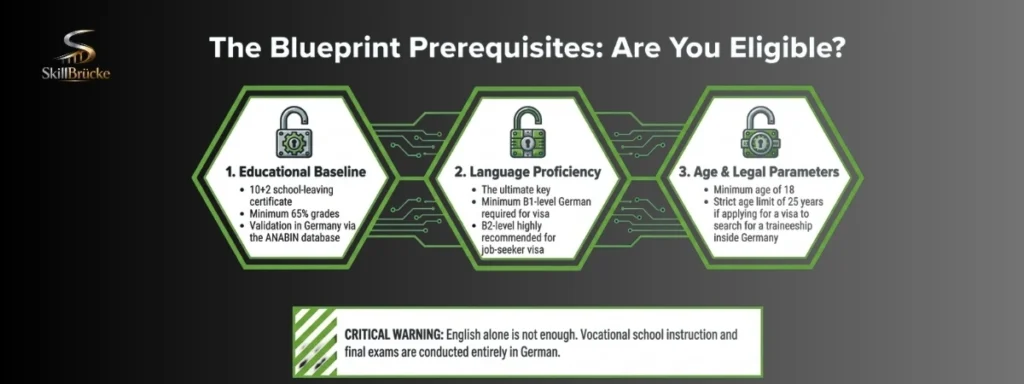
Germany has lowered entry barriers, but the threshold for quality remains high. International applicants must navigate the following:
- Educational Validation: A school-leaving certificate is required. For the strategist, the ANABIN database is the first stop to verify if your local qualification matches German standards.
- Age Dynamics: While there is no formal upper age limit to start Vocational Training Courses in Germany, applicants for the “Visa to Look for a Traineeship” must be under 25.
- Internship Advantage: Strategically, completing a relevant internship in your home country is a critical differentiator that proves your interest in the trade to German HR managers.
German Language Proficiency: The Key to Integration
Linguistic competence is the primary predictor of vocational success. Because both the vocational school instruction and the final Chamber exams are conducted exclusively in German, the requirements are:
- B1 Level: The legal minimum for a vocational visa.
- B2 Level: The strategic recommendation for the job-search phase and for surviving the technical nuances of the vocational school (Berufsschule).
- Professional Logic: Understanding technical German is essential for passing the written components of the final exam, where AI assistance or translation tools are prohibited.
How Can an Ausbildung Help Me Settle in Germany Permanently?
The long-term stability of the German model is evidenced by a 6.9% youth unemployment rate, compared to the significantly higher EU average.
- Employment Guarantee: 66% of trainees are hired by their training company immediately.
- Permanent Residency (PR): Graduates can apply for a settlement permit after 5 years (including the training years).
- The “Meister” Route: Graduates can pursue Master Craftsman status, allowing them to open their own business and train others.
Post-Graduation Career Pathways, PR, and Higher Education
Completing an Ausbildung is not an educational dead end; it is a springboard into the European labor ecosystem. The dual training system provides graduates with a federal qualification that carries significant weight across all 27 EU member states.
The Job Seeking and Immigration Acceleration Track
Upon passing the final standardized exams (Abschlussprüfung), the graduate’s vocational residence permit expires, making way for an immediate transition into professional employment.
- The Job-Seeking Visa Layer: If the hosting employer does not offer a permanent position, the graduate is entitled to an extended 12-month job-seeking residence permit. This allows them to work full-time in any field to support themselves while looking for a qualified position matching their trade.
- Accelerated Permanent Residency (PR): Under the current provisions of the Skilled Immigration Act, international graduates of German vocational programs can apply for permanent residency after holding a skilled worker job for just 24 months, down from historical 48-month mandates.
- Fast-Track Citizenship: Time spent in a dual Ausbildung program counts toward the residency years needed for naturalization. Graduates who integrate well and demonstrate stable employment can apply for German citizenship within 3 to 5 years of completing their training.
What Challenges Do International Trainees Face and How to Overcome Them?
Securing a placement in crowded urban centers can be difficult, making regional arbitrage a smart strategy when applying for Vocational Training Courses in Germany.
- Regional Arbitrage: Strategically apply in East Germany or smaller towns where the shortage of applicants is most severe.
- Support Systems: Utilize VerA (Senior Expert Coaches) for individual mentoring and Assisted Training (AsA) for socio-pedagogical support and language tutoring.
- Block Intensity: Be prepared for the academic rigor of vocational school periods.
Conclusion
Vocational Training Courses in Germany have become one of the best international career pathways for students seeking affordable education, practical learning, and stable employment opportunities. Germany’s dual education system not only prepares students with industry-relevant skills but also allows them to earn while studying, making it financially attractive for international applicants.
FAQs
Can I switch from University to Ausbildung?
Yes. Approximately 28% of bachelor students in Germany transition to vocational training, and it is viewed as a pragmatic career pivot.
Is there an age limit for starting training?
No formal limit for the training itself, but the “Searching for a Traineeship” visa is restricted to those under 25.
How many days of paid leave do I get?
The legal minimum is 24 days, typically taken during vocational school holidays.
Does time spent during an Ausbildung count toward permanent residency?
Yes. The 2 to 3.5 years spent living in Germany on an active vocational training visa count toward the total residency years required for long-term immigration status. Following graduation, working as a qualified specialist for just 24 months enables the individual to apply for permanent residency status (Niederlassungserlaubnis).
What happens if I fail my final vocational exams?
If an apprentice fails the final standardized examination (Abschlussprüfung), the corporate training contract can be extended upon request until the next scheduled exam date, up to a maximum extension of one year. The trainee remains employed and continues to receive their monthly stipend during this period.
Related Post
Ausbildung Requirements for Indian
Ausbildung Courses in germany
Ausbildung consultant in Bhopal