Germany’s dual vocational training system (Duale Ausbildung) has emerged as one of the most attractive international career pathways for young Indian high school graduates, diploma holders, and working professionals. By combining tuition-free classroom learning at a vocational school (Berufsschule) with hands-on, paid on-the-job training at a German enterprise, the system allows candidates to earn a monthly stipend while building a future-proof career.
Understanding Germany Ausbildung Eligibility for Indian Students is the crucial first step to navigating this pathway. According to the Federal Institute for Vocational Education and Training (BIBB Berufsbildungsbericht), German industries face a shortfall of over 54,000 unfilled training positions. To bridge this gap, Germany’s updated Skilled Immigration Act (Fachkräfteeinwanderungsgesetz) simplifies entry requirements for non-EU applicants.
Key Highlights: Germany Ausbildung at a Glance
| Parameter | Details / Figures for Indian Applicants |
| System Type | Duale Ausbildung (70% Work Experience, 30% Berufsschule Classroom) |
| Program Duration | 2 to 3.5 years (Depending on specialization) |
| Academic Requirement | 12th Pass (Higher Secondary) with min. 50%–60% or 10th + ITI/Diploma |
| Language Requirement | German B1 (Technical/Commercial) or German B2 (Healthcare/Nursing) |
| Age Criteria | Preferred age 17–27 years (up to 30+ with relevant work experience) |
| Monthly Stipend (2026) | €724 to €1,500+ / month (₹66,000 – ₹1,37,000 INR approx.) |
| Blocked Account Limit | €11,904/year (€992/month) – Waived if stipend meets threshold |
| Visa Application Fee | €75 (₹6,800 INR) payable at VFS Global |
| Post-Training Pathway | Direct employment contract + PR eligibility after 2 years of employment |
Core Pillars of Germany Ausbildung Eligibility for Indian Students
To qualify for a vocational training contract (Ausbildungsvertrag) and secure the corresponding German National Visa under Section 16a of the Residence Act (Aufenthaltsgesetz), Indian applicants must meet criteria across four core categories:
1. Educational & Academic Requirements
Germany’s education system uses distinct secondary school classifications: Hauptschule (9 years), Realschule (10 years), and Abitur (12–13 years). For international evaluations through the Anabin database or ZAB (Zentralstelle für ausländisches Bildungswesen), Indian qualifications align as follows:
- 12th Pass (Higher Secondary Certificate – HSC / AISSCE): Recognized as equivalent to the German Mittlere Reife or Fachhochschulreife. This is the standard qualification required for over 85% of dual vocational training positions.
- 10th Pass + ITI (Industrial Training Institute): Highly valued for technical trades such as Electrician, Fitter, Turner, and Machinist.
- Polytechnic Diploma (3 Years): Equivalent to advanced technical entry; often allows candidates to shorten their Ausbildung program from 3.5 years down to 2 or 2.5 years.
- Bachelor’s Degree Holders (B.A., B.Com, B.Sc, B.Tech): Indian graduates are eligible to apply if they wish to pivot into a practical career path in Germany.
Academic Eligibility Matrix by Stream
| Indian Qualification | Equivalent German Level | Eligible Ausbildung Trades | Preferred Minimum Marks |
| 12th Science (PCM/PCB) | Mittlere Reife / Abitur | Mechatronics, IT, Nursing, Medical Assistant, Automotive | 55% – 60% aggregate |
| 12th Commerce | Mittlere Reife | E-Commerce, Logistics, Bank Clerk, Industrial Clerk | 50% – 60% aggregate |
| 12th Arts / Humanities | Mittlere Reife | Hotel Management, Gastronomy, Elderly Care, Retail | 50% aggregate |
| 10th + 2-Year ITI | Hauptschulabschluss / Realschule | Fitter, Electrician, Welder, Construction Specialist | 60% in Trade Theory |
| General Nursing (GNM) | Recognized Vocational Diploma | Fast-track Nursing (Pflegefachfrau/-mann) | Pass division + State Council |
Note on Qualification Recognition: While most 12th-grade boards (CBSE, ICSE, and State Boards) are accepted directly by German employers, certain specialized fields—such as healthcare – may require a preliminary qualification evaluation via the competent German state authority (Anerkennung).
2. German Language Proficiency Standards
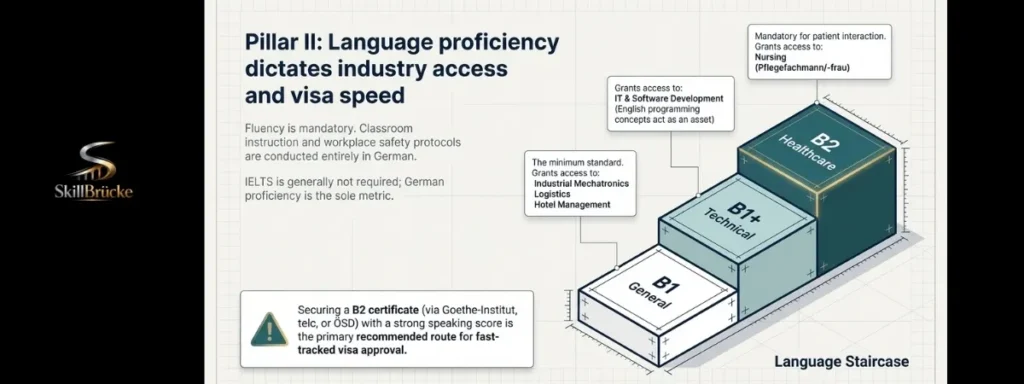
German language competence is mandatory. Because classroom instruction at the Berufsschule and workplace instruction are conducted in German, fluency is directly tied to safety and educational success.
| Field of Training | Minimum Required CEFR Level | Recommended Level for Fast Visa Approval |
| Nursing & Healthcare | B2 Level (Mandatory for patient interaction) | B2 (With strong speaking score) |
| IT & Software Development | B1 Level (English helpful, but German B1 essential) | B2 |
| Mechatronics & Electronics | B1 Level | B1+ / B2 |
| Hotel & Restaurant Management | B1 Level | B2 |
| Logistics & Warehousing | B1 Level | B1 |
3. Financial Requirements & Minimum Stipend Rules
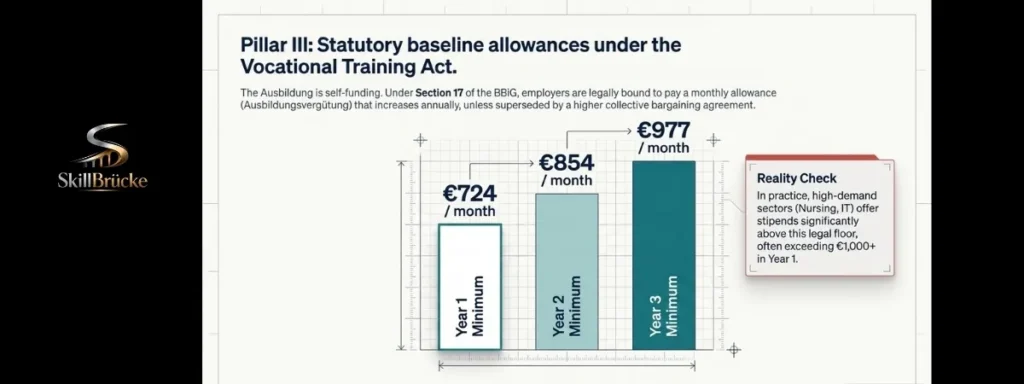
One of the greatest advantages of an Ausbildung in Germany is that it is self-funding. Under Section 17 of the Vocational Training Act (Berufsbildungsgesetz – BBiG), German employers are legally required to pay all trainees an Ausbildungsvergütung (monthly allowance) that increases with each training year.
Mandatory Statutory Minimum Allowances (BBiG Rates)
The German federal government sets a statutory floor for monthly stipends. Employers cannot pay below these rates unless bound by a higher collective bargaining agreement (Tarifvertrag):
- Year 1: Minimum €724 / month
- Year 2: Minimum €854 / month
- Year 3: Minimum €977 / month
In practice, high-demand sectors pay significantly more than the legal baseline.
The Blocked Account (Sperrkonto) Calculation
To issue a vocational training visa, the German embassy requires proof that the candidate can cover basic living expenses.
- Standard National Proof-of-Funds Baseline: €992 / month (€11,904 per year).
- Gross Stipend Offset Threshold: €1,048 gross / month (equivalent to €822 net after social security deductions).
How Your Stipend Impacts the Blocked Account
- Scenario A (Stipend ≥ €1,048/month): If your signed contract guarantees €1,100/month in Year 1 (common in nursing, IT, and industrial engineering), no blocked account is required. The contract itself serves as full financial proof.
- Scenario B (Stipend < €1,048/month): If your contract offers €800/month, a financial gap exists relative to the €1,048 threshold. You must set up a partial blocked account to bridge the difference (€1,048 – €800 = €248/month shortfall $\times$ 12 months = €2,976 deposit).
4. Criteria & Professional Experience Guidelines
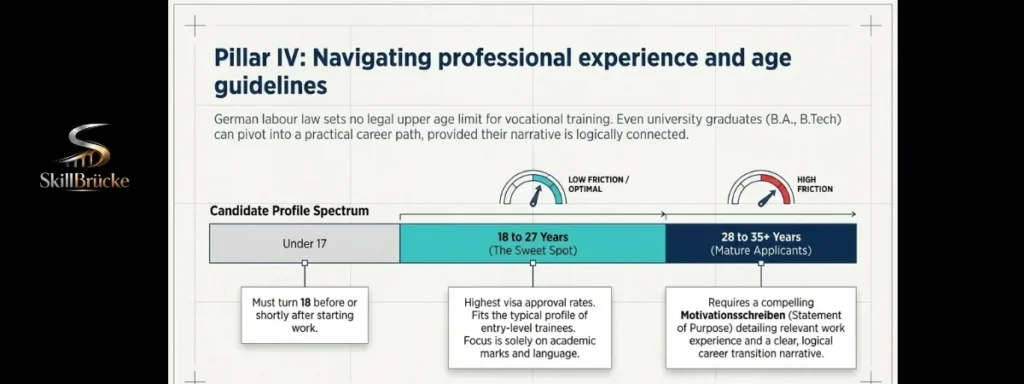
German labor law sets no legal upper age limit for vocational training. However, practical factors influence candidate selection:
- Minimum Age: 17 years (must turn 18 before or shortly after starting work).
- Sweet Spot (18 to 27 Years): Applicants in this bracket experience the highest visa approval rates, as they fit the typical profile of entry-level trainees.
- Mature Applicants (28 to 35+ Years): Candidates over 28 can successfully secure positions provided they show relevant work experience or a clear career transition narrative in their Statement of Purpose (Motivationsschreiben).
Sector-Specific Criteria for Indian Applicants
Understanding Germany Ausbildung Eligibility for Indian Students requires looking closely at field-specific demands. Different industries maintain distinct prerequisites:
1. Nursing & Healthcare (Pflegefachmann / Pflegefachfrau)
Healthcare remains the largest sector seeking international talent in Germany.
- Education: 12th pass (Science preferred, but Arts/Commerce accepted); GNM or B.Sc Nursing candidates from India receive fast-track consideration.
- Language: Strict B2 German Certificate (Goethe or telc).
- Health Requirements: Physical fitness certificate and vaccination records (e.g., Measles, Hepatitis B).
- Police Clearance: Clean Police Clearance Certificate (PCC) from Passport Seva Kendra.
- Average Stipend: €1,341 (Year 1) to €1,503 (Year 3) per month.
2. Information Technology (Fachinformatiker)
Includes specializations in Application Development (Anwendungsentwicklung) and System Integration (Systemintegration).
- Education: 12th Standard with Mathematics, Computer Science, or Physics; 3-year Diplomas or BCA drops are welcome.
- Language: B1 German minimum (B2 preferred). basic proficiency in English programming concepts is an asset.
- Technical Skills: Exposure to Java, Python, C++, SQL, or networking basics gives candidates a strong competitive edge during employer interviews.
- Average Stipend: €1,050 to €1,300 per month.
3. Industrial Mechatronics & Automotive (Mechatroniker)
- Education: 12th Science (PCM) or 10th + 2-year ITI Diploma in Electrical/Mechanical trades.
- Language: B1 German.
- Practical Aptitude: Strong spatial reasoning and physical mechanics foundation.
- Average Stipend: €1,000 to €1,250 per month.
Document Checklist for German Visa Application
When evaluating Germany Ausbildung Eligibility for Indian Students, the German Embassy (VFS Global) scrutinizes paperwork closely. All Indian academic records must be accompanied by certified German translations.
Mandatory Document Portfolio
- Valid Indian Passport: Must have at least 12 months of validity remaining and 2 blank pages.
- Signed Training Contract (Ausbildungsvertrag): Signed by both the candidate and the German employer, detailing job role, monthly stipend, and training hours.
- Approval from the Federal Employment Agency (Pre-Approval / Vorzustimmung): Obtained by your employer via the Bundesagentur für Arbeit.
- Proof of Educational Qualifications: 10th, 12th, ITI, or Diploma mark sheets and passing certificates.
- Language Certificate: Original B1 or B2 certificate from Goethe-Institut, telc, or ÖSD.
- German-Style CV (Lebenslauf): In chronological table format, signed manually.
- Motivation Letter (Motivationsschreiben): A one-page letter explaining career goals, interest in Germany, and chosen trade.
- Proof of Accommodation / Training Plan: Details of initial living arrangements arranged by the employer or candidate.
- Health Insurance (Krankenversicherung): Valid coverage starting from departure date until enrollment in the German state healthcare scheme.
- Police Clearance Certificate (PCC): Issued by Passport Seva Kendra (PSK).
Post-Completion Career & Permanent Residency (PR) Pathway
Completing an Ausbildung opens up long-term career perspectives in Europe.
- Immediate Employment Retention: Approximately 80% to 85% of trainees are absorbed directly by their training company into full-time roles upon graduation.
- Competitive Starting Salaries: Qualified professionals (Fachkräfte) earn starting gross salaries between €2,800 and €4,200 per month (₹2.5 Lakhs – ₹3.8 Lakhs INR approx.), depending on the trade and region.
- Fast-Track Permanent Residency (PR): Under Section 18g of the updated German Residence Act, international graduates of German vocational programs can apply for a Settlement Permit (Niederlassungserlaubnis) after just 24 months of full-time employment and pension contributions.
- Further Education (Meister / Fachwirt): Graduates can pursue advanced certifications to become a certified Master Craftsman (Meister), granting the right to start their own business or pursue higher technical studies at universities.
Conclusion
Understanding the Germany Ausbildung Eligibility for Indian Students is the first step towards building a realistic application strategy. The most important requirements generally include a suitable school-leaving qualification, strong German language skills, a genuine training contract, complete documentation, health insurance and sufficient financial resources where required.
There is no universal maximum age limit for starting Ausbildung, and even university graduates may pursue vocational training. However, applicants must select a profession carefully and demonstrate that their education, experience, language ability and career plans are logically connected.
FAQs
What is the minimum qualification for Ausbildung in Germany?
There is no single qualification that applies to every Ausbildung. For dual training, the company generally decides its selection criteria. Some employers may accept Class 10, while others prefer Class 12 or higher qualifications.
Can Indian students apply for Ausbildung after Class 12?
Yes. Class 12 students can apply for many vocational training programmes, provided they meet the specific academic, language and employer requirements.
Is German mandatory for Ausbildung?
German is generally essential because training, workplace communication and examinations commonly take place in German. B1 is a widely used general benchmark, although specific visa and programme requirements can differ.
Can I do Ausbildung without IELTS?
IELTS is generally not the standard language requirement for Ausbildung. German proficiency is usually more important. A specific employer or programme may have additional requirements.
Is APS required for Ausbildung?
APS should not automatically be treated as a universal requirement for every Ausbildung applicant. The latest visa instructions for the relevant vocational training category should be checked carefully.
Related Post
Bakery Ausbildung in Germany
Hotel Management Ausbildung in Germany
Dental Assistant Ausbildung in Germany
Nursing Ausbildung in Germany