Germany has become one of the most attractive destinations for international students seeking practical education and stable career opportunities. Among all vocational programs, Nursing Ausbildung in Germany stands out because it combines paid training, internationally recognised qualifications, and excellent employment prospects after graduation.
Unlike traditional university degrees, this vocational training program allows students to earn a monthly stipend while learning. As Germany continues to experience a shortage of qualified healthcare professionals due to its ageing population, trained nurses are in high demand across hospitals, rehabilitation centres, elderly care facilities, and home healthcare services.
Key Highlights: Nursing Ausbildung in Germany
- What is Nursing Ausbildung in Germany?
- Eligibility Requirements for Nursing Ausbildung in Germany
- German Language Requirements
- Stipend During Nursing Ausbildung in Germany
- Post-Qualification Salary Growth (Qualified Nurse to Management)
- The 3-Year Training Journey: Rotations and Exams
- Documentation and the “Apostille” Process
- The Visa Navigator: Section 16a and the Opportunity Card
- Living in Germany: Integration and Cost of Living
- The Pathway to Permanent Residency (PR) and Citizenship
- Conclusion
- FAQs
What is Nursing Ausbildung in Germany?
Nursing training in Germany is a three-year dual vocational training programme designed to prepare students for professional nursing careers. It combines classroom-based education with hands-on clinical experience in hospitals and healthcare institutions.
The programme follows Germany’s renowned dual education system, where students divide their time between vocational schools and practical training in healthcare facilities. This ensures graduates are job-ready from the first day of employment.
After the implementation of the General Nursing Act (Pflegeberufegesetz), nursing education in Germany has become more integrated. Students receive comprehensive training covering:
- General nursing
- Elderly care
- Paediatric nursing
- Emergency care
- Rehabilitation nursing
- Community healthcare
Upon successful completion, graduates become qualified professional nurses eligible to work across Germany and, in many cases, other European countries after meeting local licensing requirements.
Eligibility Requirements for Nursing Ausbildung in Germany
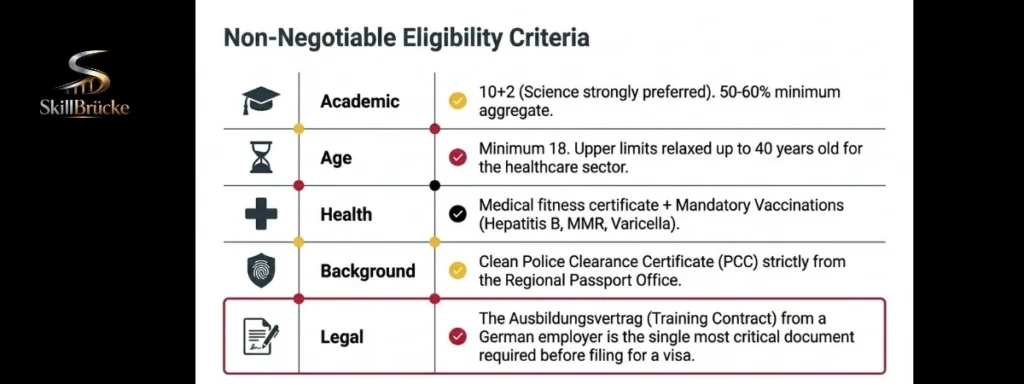
To apply for Ausbildung as a nurse in Germany, applicants generally need to meet the following criteria:
| Category | Requirement | Details & Notes |
| Academic | School Leaving Certificate | Candidates must have completed Class 12 (10+2) or an equivalent secondary diploma recognized as Abitur or Realschulabschluss. A Science stream (Biology/Chemistry) is strongly preferred. Minimum aggregate marks of 50–60% are generally recommended |
| Language | German Proficiency | A B1 level certificate is the mandatory minimum for the visa, but B2 level is strongly preferred or required by most training hospitals before the programme starts. Accepted certifications include Goethe-Institut, telc, and ÖSD |
| Age | Age Limits | Applicants must typically be at least 18 years old to start. While the traditional age range was 18–30, the healthcare sector has relaxed this, allowing applicants up to 40 years of age. |
| Health | Medical Fitness | A medical certificate confirming the applicant is physically and mentally fit for nursing work is required. Proof of mandatory vaccinations is essential, specifically for Hepatitis B, Measles, Mumps, Rubella (MMR), and Varicella (Chickenpox) |
| Background | Police Clearance | A clean criminal record verified through a Police Clearance Certificate (PCC) from the candidate’s country of origin is mandatory |
| Legal | Training Contract | A signed training contract (Ausbildungsvertrag) from a German healthcare employer is the single most critical document needed before filing for a visa |
| Personal | Soft Skills | Institutions look for high motivation, empathy, reliability, and the ability to communicate clearly during German-language interviews. Previous practical experience, such as an internship or Voluntary Social Year (FSJ), is a major advantage. |
German Language Requirements
German language proficiency is one of the most important eligibility criteria because nurses communicate with patients, doctors, and hospital staff daily.
Most employers expect candidates to have at least B1 level German, while some hospitals and nursing schools prefer B2 level before the training begins.
Accepted German Language Certificates
| Certificate | Accepted by Most Employers |
| Goethe-Zertifikat | Yes |
| TELC German | Yes |
| ÖSD Certificate | Yes |
| TestDaF (where applicable) | Yes |
Which Level is Best?
| Level | Suitable For |
| A2 | Basic understanding (generally not enough for nursing) |
| B1 | Minimum requirement for many employers |
| B2 | Preferred by many hospitals and improves admission chances |
A higher German proficiency not only increases your chances of selection but also helps you adapt more easily during clinical training and patient interactions.
Stipend During Nursing Ausbildung in Germany
During your Nursing Ausbildung in Germany, you will receive a monthly training stipend (Ausbildungsvergütung) that increases each year. The exact amount depends on the region, the specific employer, and the applicable collective bargaining agreement, such as the TVAöD for public service.
Monthly Stipend Breakdown
The following table provides a general range of the gross monthly stipends you can expect across different sectors:
| Training Year | Public Sector (e.g., TVAöD) | Church-Affiliated (e.g., Caritas) | Private Healthcare Chains |
| Year 1 | €1,100 – €1,340 | €950 – €1,100 | €900 – €1,100 |
| Year 2 | €1,200 – €1,400 | €1,050 – €1,150 | €1,000 – €1,150 |
| Year 3 | €1,300 – €1,503 | €1,150 – €1,250 | €1,100 – €1,250 |
Key Financial Details
- Net Income: The figures above are gross amounts. Approximately 20–30% is deducted for social security contributions, including health, pension, unemployment, and long-term care insurance. However, trainees often pay little to no income tax if their earnings fall below the tax-free basic allowance.
- Shift Bonuses: You can significantly increase your monthly take-home pay by working “unsocial hours.” Legally mandated bonuses include:
- Night shifts: 25–30% extra per hour
- Sundays: 40–50% extra per hour
- Public Holidays: 100–150% extra per hour
- Additional Benefits: Many employers provide an annual Christmas bonus (often a 13th-month salary) and subsidies for public transport or on-site dormitory housing, which can cost between €200 and €400 per month.
- Financial Independence: For most international students, the stipend is sufficient to cover living costs, which typically range between €700 and €950 per month depending on the city. Because you are paid a salary, you generally do not need a blocked account for your visa application if your contract meets the minimum income requirements.
Post-Qualification Salary Growth (Qualified Nurse to Management)
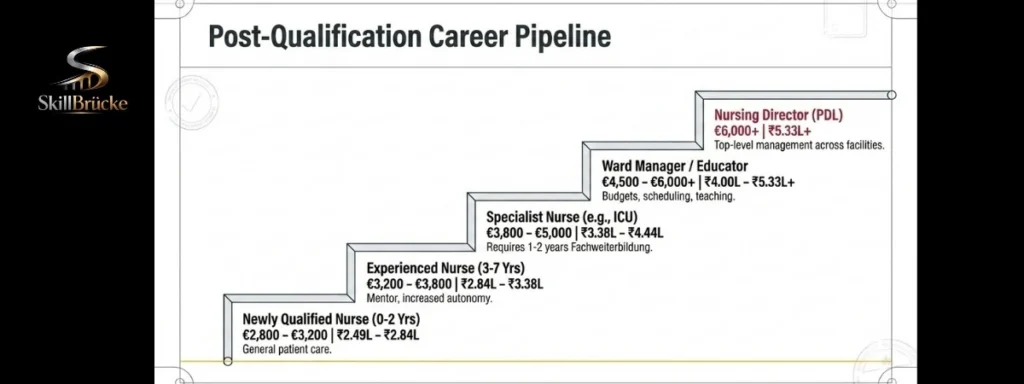
After completing your training and passing the Staatsexamen, your salary will grow significantly as you gain experience and move into specialized or management roles.
| Career Stage / Role | Gross Monthly Salary (EUR) | Gross Monthly Salary (INR Approx.) | Details & Responsibilities |
| Newly Qualified Nurse (0–2 Years) | €2,800 – €3,200 | ₹2,49,000 – ₹2,84,500 | General patient care in hospitals or clinics; entry-level registered nurse status |
| Experienced Nurse (3–7 Years) | €3,200 – €3,800 | ₹2,84,500 – ₹3,38,000 | Increased autonomy; mentor for trainees; higher base pay due to accumulated years of service |
| Specialist Nurse (e.g., ICU, Anesthesia) | €3,800 – €5,000 | ₹3,38,000 – ₹4,44,500 | Requires 1–2 years of Fachweiterbildung (specialized training); deals with complex medical cases |
| Ward Manager / Nurse Educator | €4,500 – €6,000+ | ₹4,00,000 – ₹5,33,500+ | Responsibility for unit personnel, budgets, and scheduling, or teaching at a nursing school |
| Nursing Director (PDL) | €6,000+ | ₹5,33,500+ | Top-level management role overseeing entire nursing departments across a facility |
The 3-Year Training Journey: Rotations and Exams
The 36-month journey is structured to produce “battle-tested” professionals. Unlike Indian nursing programs which can be overly theoretical, the German system focuses on clinical autonomy.
- Year 1 (Orientation): You focus on the fundamentals—hygiene, patient mobilization, and vital sign monitoring. You rotate through general medicine and surgery wards.
- Year 2 (Specialization): This is the “Generalist” phase. You rotate through outpatient care, geriatric facilities, and pediatrics. Under the 2020 law, you can choose a focus for the final third of your program, such as pediatric care.
- Year 3 (Consolidation): You enter high-intensity areas like the Emergency Department, Operating Theater (OR), or Intensive Care Unit (ICU).
Core Curriculum Subjects (The Berufsschule Component)
| Subject Category | Specific Learning Areas |
| Biological Sciences | Anatomy, Physiology, Pathology, Nutrition |
| Nursing Mastery | Wound Care, Care Planning, Pharmacology |
| Social Sciences | Patient Psychology, Professional Ethics |
| German Law | Healthcare Legislation, Insurance Standards |
The program concludes with the Staatliche Abschlussprüfung (State Exam), which involves a three-part evaluation: a written exam, a practical clinical assessment on a real patient, and an oral exam focusing on clinical reasoning.
Documentation and the “Apostille” Process
The most common reason for application failure isn’t academic – it is documentation error. For students in Kerala and Punjab, the verification of certificates can be a lengthy ordeal due to backlogs at State Nursing Councils and Education Boards. In 2026, German authorities require a precise four-step authentication:
- Notarization: Local verification.
- State HRD: Crucial verification from your state’s education department (e.g., Kerala HRD).
- MEA Apostille: Final Indian government verification.
- Sworn Translation: Must be performed by a German-recognized “beeidigter Übersetzer.
Mandatory Document Checklist for Indian Applicants
| Document | Special Requirement |
| 10th & 12th Marksheets | MEA Apostille + Sworn German Translation |
| Medium of Instruction (MoI) | Certificate stating 12th was in English |
| Language Certificate | Original (Goethe/TELC/ÖSD B1 or B2) |
| Hepatitis B Vaccination | Documented proof of complete dosage |
| Police Clearance (PCC) | Issued by Regional Passport Office (RPO) |
| Motivation Letter | 1-page PDF in professional German |
The Visa Navigator: Section 16a and the Opportunity Card
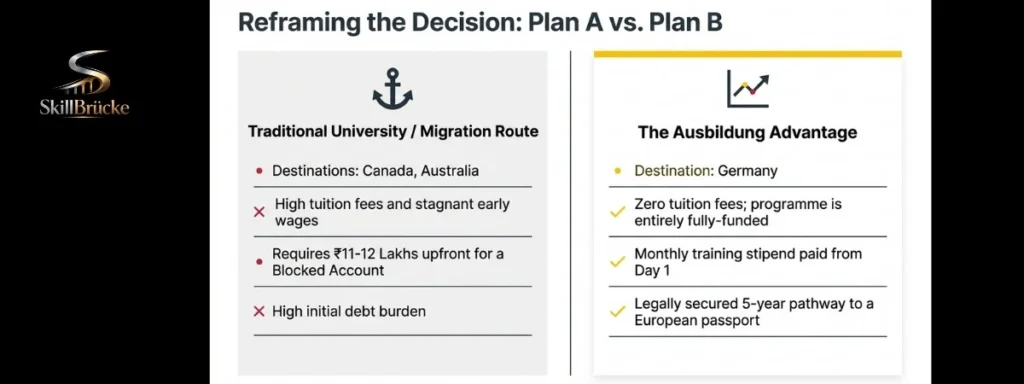
Relocating to Germany is governed by the Skilled Immigration Act. Most trainees apply for the Section 16a Visa (Vocational Training). A significant advantage for nursing students in 2026 is that if your stipend is high enough (typically above €939 net), you are exempt from the Blocked Account (Sperrkonto) requirement. This saves Indian families from the burden of depositing ₹11-12 Lakhs upfront.
Alternatively, the Opportunity Card (Chancenkarte) is a points-based system that allows you to enter Germany for 9 months to find an Ausbildung position in person. Under this card, you are permitted to work up to 20 hours per week in a part-time job while you interview with hospitals.
Financial Proof for Visa
| Visa Type | Blocked Account Needed | Work Rights |
| Direct Ausbildung (16a) | No (if stipend is high) | Full time training + 20 hrs part time |
| Opportunity Card | Yes (approx. €1,000/month) | 20 hrs part-time while searching |
| Language Search Visa | Yes | Study only (limited work) |
Based on the experience of successful students like Khushi (Haryana), the VFS Global interview is where confidence matters. When asked “Why this hospital?” or “Why Dortmund?”, do not give a memorized answer. Mention specific rotations or the hospital’s specialty in oncology or surgery. This shows the officer you are a serious professional.
Living in Germany: Integration and Cost of Living
Cultural adaptation is the “invisible” part of the Nurse training program Germany. You will encounter “Direct Communication” – Germans are blunt and value efficiency. This is often a shock to Indian students used to more indirect social styles. However, the integration support in 2026 is superior.
Many hospitals now offer “Wohnheim” (staff housing). For example, the TalentOrange Campus in Neu-Isenburg provides 30 modern dorm rooms, community kitchens, and social integration workshops. Living on campus reduces your rent to approximately €300–€400, allowing for massive savings.
Regional Cost of Living Comparison (Monthly Estimates)
| Category | Small City (e.g., Neu-Isenburg) | Metro (e.g., Munich/Frankfurt) |
| Rent (Staff/Shared) | €250 – €400 | €600 – €900 |
| Food/Groceries | €200 – €300 | €300 – €400 |
| Public Transport | €63 (Deutschlandticket) | €63 (Deutschlandticket) |
| Savings Potential | Very High | Moderate |
The Pathway to Permanent Residency (PR) and Citizenship
The Skilled Immigration Act has made Germany the most direct route to a European passport. The “3+2 Rule” is the standard: 3 years of training followed by 2 years of work as a qualified nurse.
For students from Kerala, the “Triple Win” project (a collaboration between GIZ and the Federal Employment Agency) offers an even more protected route, with dedicated integration officers accompanying the trainee throughout their journey.
Step-by-Step Milestones:
- Arrival: Secure a 16a Residence Permit.
- Year 3: Pass the State Exam; convert to a Section 18a Skilled Worker Visa.
- Year 5: Eligible for Permanent Residency (Settlement Permit).
- Year 5 (New Law): Eligible to apply for German Citizenship and hold dual nationality.
Conclusion
The Nursing Ausbildung in Germany is not just an education; it is a strategic escape from the stagnant wages and high costs of traditional nursing degrees. It offers a path where your talent is respected, your training is free, and your future is legally secured by the German state. Success on this path requires pragmatism. If you original goal was Canada or Australia but the costs were too high, Germany is your destiny. As Khushi’s story illustrates, the “Plan B” of Germany often becomes the “Plan A” for a successful life.
FAQs
Is there an age limit?
While the law is flexible, institutions prefer those under 30. However, candidates up to 35 with relevant experience or a strong motivation letter are frequently accepted in 2026.
Can I bring my spouse?
Only after you qualify and secure a full-time job (post-Ausbildung), supporting a spouse on a trainee stipend is financially impossible under visa rules.
What if I only have B1 German?
You can apply for the Nursing Assistant (Pflegehilfe) program (1-2 years) and later bridge into the full nursing degree.
Is 12th Commerce or Arts eligible?
Yes, but you will face higher competition than Science students. A strong B2 language certificate is your best tool to overcome a non-science background.
What happens if I fail the State Exam?
You are usually allowed two additional attempts. Your hospital will typically extend your trainee contract to allow for more study time.
Related Post
Ausbildung Courses in germany
Germany Ausbildung Requirements for Indian
Vocational training courses in Germany