Germany’s healthcare sector is undergoing a massive transformation as we head into 2026, driven by an aging population and a sophisticated technological shift. For Indian students, the Medical Assistant Ausbildung in Germany represents the most strategic entry point into this stable economy. While many pursue traditional degrees, the German “Dual System” is a high-level vocational model that essentially functions as a three-year paid internship.
It solves the dual problem of rising education costs and the “experience gap” by ensuring you are fully integrated into a clinical environment from day one. In the current 2026 landscape, this hybrid approach is no longer just a training option; it is a vital solution for Germany’s medical infrastructure, offering immediate job readiness in a way that purely academic routes cannot.
To navigate this successfully, you must transition from seeing yourself as a student to viewing yourself as a future healthcare professional with a diverse, high-stakes portfolio of responsibilities.
Key Highlights: Medical Assistant Ausbildung in Germany
- Defining the Role: What is a Medizinische Fachangestellte (MFA)?
- Program Overview and Training Structure – Medical Assistant Ausbildung
- Eligibility and Educational Prerequisites
- Anatomy of the Program: Structure and Duration
- Language Proficiency: The B2 Benchmark
- Stipend and Cost: Medical Assistant Ausbildung in Germany
- Career Prospects and Long-term Growth
- Strategic Evaluation: Humanizing the German Work Culture
- Conclusion
- FAQs
Defining the Role: What is a Medizinische Fachangestellte (MFA)?
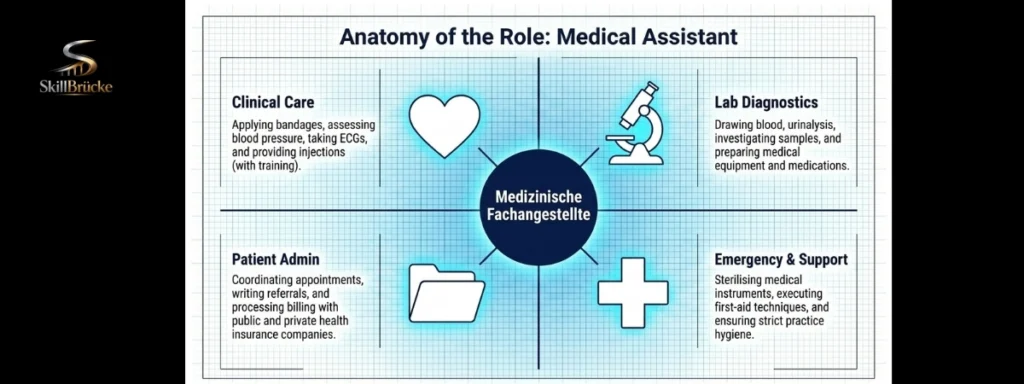
A Medizinische Fachangestellte (MFA) is far more than a simple assistant; they are the operational backbone of the German outpatient clinic. In modern German medicine, the role has evolved into that of a “Practice Manager.” You are the first person a patient sees and the last person who ensures their treatment is documented and billed correctly.
As a participant in a Medical Assistant Ausbildung in Germany, your core responsibilities include:
- Patient Coordination: Managing the intake process, scheduling specialized appointments, and acting as the primary triage point.
- Clinical Support: Directly assisting physicians during examinations and minor surgical procedures.
- Laboratory & Diagnostics: Drawing blood, performing ECGs, assessing vital signs, and preparing urine samples for analysis.
- Administrative Mastery: Managing digital medical records and navigating the complex German billing systems (GKV/PKV).
- Health Promotion: Coordinating vaccinations, screenings, and providing patient aftercare instructions.
This role requires a high degree of “Vocational Maturity” – a German standard of professional readiness where technical precision meets high-level empathy.
Program Overview and Training Structure – Medical Assistant Ausbildung
The dual system splits your time between a vocational school (Berufsschule) and a medical practice. This structure ensures that theoretical knowledge of anatomy and physiology is immediately tested in clinical settings.
| Course Overview: Medical Assistant Ausbildung in Germany | Details |
| Duration | 3 Years (Shortening possible for high performers) |
| Training Type | Dual System (School + Hands-on Practice) |
| Weekly Hours | 39 Hours per week |
| Annual Vacation | 30 Working days |
| Standard Intake | August 1st annually |
The August 1st intake is strict. High-performing students with previous relevant experience or exceptional school grades can often shorten this period to 2.5 years, accelerating their move into a fully qualified salary bracket.
Eligibility and Educational Prerequisites
For Indian applicants, the selection process is rigorous. While German clinics are eager to hire, they look for specific educational foundations and health clearances.
| Eligibility Criteria for Indian Students | Requirement | Significance |
| Educational Qualifications | 12th Pass (HSC/SSSC) | Science (PCB/PCM/PCMB) is strongly preferred. |
| Age Limit | Ideal: 17–30 Years | Younger candidates show higher “Vocational Maturity.” |
| Language Level | B2 (Goethe/TELC/ÖSD) | Non-negotiable for clinical safety and school. |
| Medical Fitness | Full Health Clearance | Mandatory vaccinations under §23a |
Mandatory Vaccinations (§23a): To enter a German clinic, you must provide proof of vaccination for Measles, Mumps, Rubella (MMR), Hepatitis A and B, Chickenpox (Varicella), and COVID-19 (as per individual employer requirements).
Strategic Advice: If you are a licensed doctor in India, do not confuse this with the “deficit letter” route for clinical recognition. The Ausbildung is for those starting their professional medical journey or seeking a more stable, structured integration pathway.
Anatomy of the Program: Structure and Duration
The standard duration of the training is 3 years, typically starting on August 1st. However, shortening the period (to 2 or 2.5 years) is possible under specific conditions, such as holding an “Abitur-equivalent” (12th grade with high marks) or having relevant medical experience in India (source: JGU Mainz).
The Dual Framework: School and Practice
The training is split between two pillars:
- Berufsbildende Schule 3 (Mainz): Trainees attend a specific vocational school, such as BBS 3 in Mainz, to study theoretical subjects. This includes anatomy, physiology, and hygiene, but also essential administrative topics like Economics and Social Studies.
- Clinical Practice: Training occurs in specialized environments. For instance, at JGU Mainz, practice takes place in the Department of Sports Medicine and through inter-company internships.
Core Responsibilities
Trainees are progressively entrusted with:
- Clinical Support: Taking blood pressure, drawing blood samples, performing ECGs, and administering injections under supervision.
- Administrative Management: Scheduling, managing digital files, and handling patient correspondence.
- Laboratory Work: Performing urine analyses and preparing biological samples for lab examination.
- Billing: Processing medical billing with both Statutory (GKV) and Private (PKV) health insurance providers (source: Meduclinic).
The structure of the Medical Assistant Ausbildung in Germany follows a 39-hour work week, ensuring you are treated as a professional employee from day one.
Language Proficiency: The B2 Benchmark
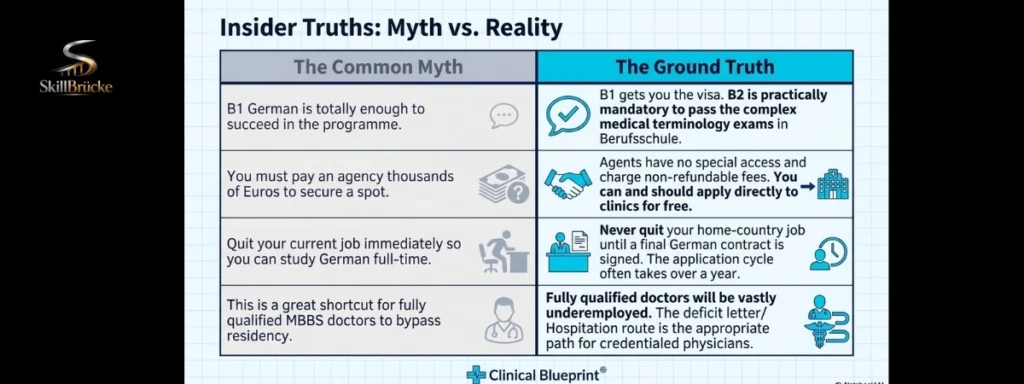
While the legal minimum for a visa might sometimes be cited as B1, the reality for a Medical Assistant Ausbildung in Germany is different. In a high-pressure clinic in Berlin or Munich, B1 proficiency results in immediate rejection.
| Language Requirements | Benchmark Level |
| Minimum for Visa | B1 (Technically possible, but risky) |
| Clinical Requirements | B2 Preferred/Mandatory |
| Accepted Certificates | Goethe, ÖSD, TELC, TestDaF |
The “So What?” Factor: Settling for B1 is a high-risk strategy. In medical settings, a misunderstanding is a patient safety issue. If you cannot communicate clinical instructions or document symptoms accurately, you will fail the probationary period. Investing in B2 before arrival is the single best way to ensure financial and professional stability.
Stipend and Cost: Medical Assistant Ausbildung in Germany
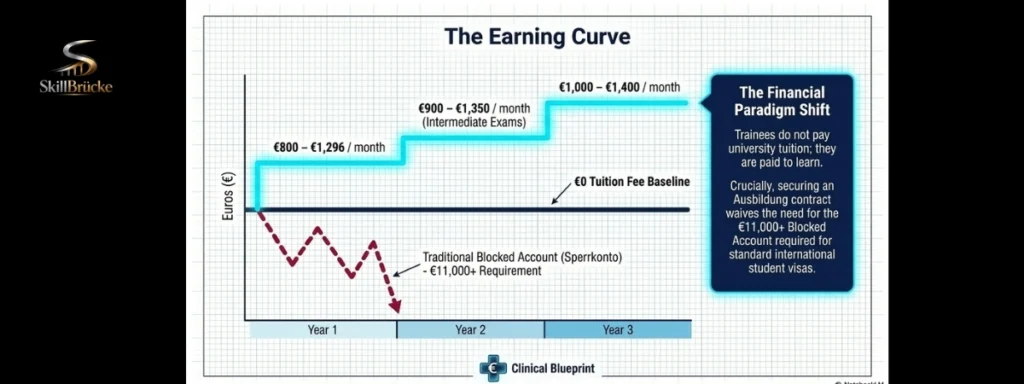
The 2026 stipend levels are a game-changer for Indian students. Effective April 2026, the pay scales have been adjusted to combat inflation, making this a financially self-sustaining path.
| Monthly Ausbildung Salary (Year-wise) – Effective April 2026 | Stipend Amount |
| Year 1 | €1,296.82 |
| Year 2 | €1,350.96 |
| Year 3 | €1,400.61 |
Additional Benefits: You are entitled to a 95% special annual payment (December bonus) and a €400 bonus for passing the final exam on your first attempt.
| Monthly Living Expenses in Germany (Estimated) | Cost |
| Rent & Utilities | €450 – €650 |
| Food & Groceries | €200 – €250 |
| Transport & Leisure | €150 – €200 |
| Total Costs | €800 – €1,100 |
Because your 2026 stipend starts at nearly €1,300, it well exceeds the German government’s residency requirement (approx. €934/month). This effectively eliminates the need for a Blocked Account, removing a massive financial hurdle for Indian families.
Career Prospects and Long-term Growth
Completing the training is merely the first step. The German healthcare system is designed to retain qualified MFAs through high job security and clear promotion paths.
From Trainee to Fachangestellte
After the final exam before the Rhenish Hesse District Medical Association, you become a “Fachangestellte.” Your salary will jump immediately. Qualified MFAs can further specialize to become Practice Managers, who oversee entire clinic operations and earn significantly higher salaries.
Salary Projection (Qualified MFA)
| Career Stage | Monthly Income (Euro) | Monthly Income (INR) |
| Qualified MFA (Entry) | €2,200 – €2,800 | ₹2,00,200 – ₹2,54,800 |
| Senior Practice Manager | €3,000 – €4,000+ | ₹2,73,000 – ₹3,64,000+ |
Residency and Settlement
Long-term success after a Medical Assistant Ausbildung in Germany depends on your integration. The program is a legal bridge to Permanent Residence (PR). After working for several years post-qualification and paying into the social security system, graduates are eligible for long-term residency, making this a permanent settlement opportunity (source: European Study Hub).
Strategic Evaluation: Humanizing the German Work Culture
Finally, the Medical Assistant Ausbildung in Germany is a life choice that requires a shift in mindset. A unique insight from the German healthcare sector is that clinical staff often teach new international trainees “like children” for the first few months. While some may find this patronizing, it is actually a sign of the German commitment to precision and safety. They want to ensure you make zero mistakes before you are given autonomy.
The Advantages:
- Financial independence from day one.
- High social standing and emotional fulfillment from helping the sick (source: KCR Consultants).
- No tuition fees and a clear path to citizenship.
The Challenges:
- High linguistic demand (B2 is non-negotiable).
- Emotional pressure of a clinical environment.
- Punctuality and direct communication style.
Conclusion
The Medical Assistant Ausbildung in Germany is the most robust and financially accessible pathway to a European career in 2026. By choosing the dual system, you are securing a world-class education while earning a salary that supports a high quality of life from day one. In the global healthcare market, a German vocational certificate is a badge of excellence that guarantees professional respect.
If you are ready to dedicate yourself to the language and the work, the German healthcare system is ready for you.
FAQs
What are the age limits for the Medical Assistant Ausbildung in Germany?
While there is no legal maximum, clinics prefer candidates under 30 as they are perceived to have higher “Vocational Maturity.” Visas for those over 30 can be more difficult to secure without extensive relevant experience.
Can I apply if I have a Commerce background?
It is possible but challenging. You must prove “Vocational Maturity” through science-related electives or healthcare experience, as clinics prioritize those with a Science/PCB background to ensure they can handle the medical theory.
Is B1 German sufficient?
No. While it is the technical minimum for a visa, most clinics and vocational schools require B2 for patient safety and academic success.
How much do I earn after the Ausbildung?
Qualified MFAs start at €2,500+ per month, with salaries increasing as you gain experience or take on management roles.
Related Post
Dental assistant Ausbildung in Germany
Nursing Ausbildung in Germany
Vocational training courses in Germany
Germany Ausbildung Requirements for Indian