Germany has become one of the most preferred destinations for vocational education because of its world-renowned dual education system, paid training programs, and strong employment opportunities. Among the various healthcare professions, Dental Assistant Ausbildung in Germany has emerged as an excellent career option for students who want practical training, a monthly stipend, and long-term career stability.
For domestic and international candidates alike, entering this profession via the dual vocational training framework (the Duales Ausbildungssystem) provides a stable, structured path to a secure, well-paid career. This comprehensive topic breaks down everything you need to know about pursuing your education, securing a placement, and succeeding in this critical healthcare sector.
Key Highlights: Dental Assistant Ausbildung in Germany
- What is Dental Assistant Ausbildung in Germany?
- Ausbildung Structure Overview
- Eligibility and Entry Requirements for Dental Ausbildung
- The Documentation and Certification Framework
- Financial Landscape: Stipends, Costs, and Living Expenses
- Career Progression and Post-Completion Salaries
- Curriculum for Dental Assistant Ausbildung in Germany
- Examination Architecture: The Path to Graduation
- Top German States and Cities for Dental Opportunities
- Conclusion
- FAQs
What is Dental Assistant Ausbildung in Germany?
Dental Assistant Ausbildung in Germany is a government-recognized vocational training program that prepares students to assist dentists in clinical procedures, patient management, hygiene protocols, laboratory tasks, and administrative responsibilities.
The official German title for this profession is Zahnmedizinische Fachangestellte (ZFA).
The Ausbildung follows Germany’s famous Dual Vocational Training System, where students divide their time between:
| BERUFSSCHULE(Vocational School: 30%) | AUSBILDUNGSBETRIEB(Dental Practice: 70%) |
| Theoretical Foundations | Hands-on Chairside Duty |
| Dental Anatomy & Disease | Direct Patient Care |
| Medical Law & Billing | Digital Systems Operations |
| Pharmacology basics | Sterilization & Hygiene |
This allows students to develop practical skills while earning a monthly stipend throughout their training.
Ausbildung Structure Overview
The German Dual System ensures that you are never just a student; you are a “Trainee” with the rights and responsibilities of an employee.
| Feature | Details | Strategic Importance for Indian Candidates |
| Program Duration | 3 Years (Standard) | Provides a comprehensive timeline to achieve professional fluency and social integration. High achievers can shorten this to 2.5 years. |
| Berufsschule (Theory) | 1–2 days per week | Focuses on medical theory, German law, and practice management. It bridges the gap between manual skill and medical knowledge. |
| Clinical Practice | 3–4 days per week | Hands-on immersion in a real German dental clinic. You earn your stipend here while learning the “German way” of patient care. |
| Assessment Phases | Mid-term & Final Exam | These nationalized exams ensure that your qualification is standardized across all 16 German federal states, ensuring mobility. |
| Degree Awarded | State-Certified ZFA | A globally recognized vocational degree that allows you to work anywhere in Europe without further recognition. |
Eligibility and Entry Requirements for Dental Ausbildung
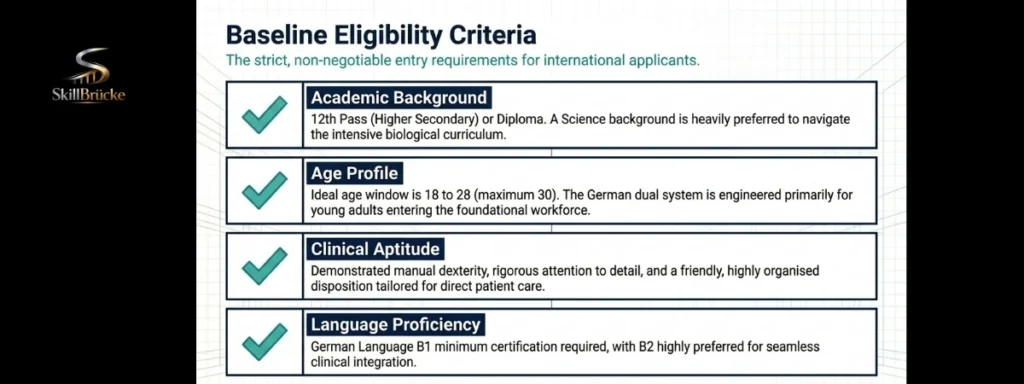
The 2026 application cycle is characterized by a high volume of international interest, making the entry requirements more standardized for Indian applicants. While the legal minimum is often a secondary school certificate, the reality of the competitive German market dictates a higher baseline for success.
Eligibility Criteria
| Criterion | Industry Standards |
| Minimum Age | 18 years |
| Maximum Age | 28–30 Years (Preferred for visa success) |
| Education | 12th Standard Pass (Science/Biology background preferred) |
| Gender Preference | Open to all; historically high female enrollment, now diversifying. |
| Soft Skills | Manual dexterity, high empathy, and meticulous punctuality. |
Language Requirements
| Level | Notes |
| B1 German | Minimum legal requirement; sufficient for basic clinical tasks. |
| B2 German | The Gold Standard. Essential for understanding medical law and billing. |
While some clinics may interview you at a B1 level, the most prestigious placements in cities like Munich or Frankfurt now demand B2. The vocabulary required for dental anatomy and German social security laws is dense; therefore, a strong B2 foundation is your best insurance against academic failure in the Berufsschule. Beyond language, manual dexterity is non-negotiable. You will be handling micro-instruments in a confined space—precision is a medical requirement, not just a preference.
The Documentation and Certification Framework
In the context of 2026 German immigration, documentation is the “make-or-break” factor. Errors in certification are the leading cause of visa delays for Indian students. Every document must be translated by a state-certified translator and, in many cases, notarized.
Required Documents for Indian Students
| Document | Required Details |
| School Leaving Certificates | 10th and 12th Marksheets (Translated & Attested) |
| APS Certification | Mandatory; validates Indian academic credentials. |
| Language Certificate | Goethe, ÖSD, or Telc (B1/B2) |
| Europass CV | Meticulously formatted German-style resume. |
| Motivation Letter | Clear explanation of your interest in German dentistry. |
| Health Clearance | Proof of vaccinations (specifically Hepatitis B and Measles). |
Since late 2022, all Indian applicants must have their school records verified by the APS office at the German Embassy in New Delhi. Without this certificate, your visa application for the Dental Assistant Ausbildung in Germany will not be processed. I advise starting this process at least 5 months before your intended departure.
Financial Landscape: Stipends, Costs, and Living Expenses
The “Earn While You Learn” model is the most significant strategic advantage for Indian families who wish to avoid the high debt associated with international education. In 2026, stipends have been adjusted upward to reflect the cost of living and the high demand for healthcare trainees.
Monthly Ausbildung Stipend by Training Year
| Training Year | Stipend Amount (Gross) |
| Year 1 | €1,000 – €1,050 |
| Year 2 | €1,100 – €1,200 |
| Year 3 | €1,200 – €1,400 |
Some high-tier clinics in Southern Germany now offer the peak of €1,400 to attract top talent.
Estimated Monthly Living Expenses
| Expense Item | Cost Range |
| Rent (Shared Flat/WG) | €350 – €550 |
| Food & Groceries | €200 – €250 |
| Public Transport | €63 |
| Insurance & Socials | Deducted from stipend (Health, Pension, Care) |
Cost Breakdown for Indian Students
| Phase | Estimated Cost |
| Language Training (A1-B2) | ₹60,000 – ₹1,50,000 |
| APS & Document Verification | ₹20,000 – ₹25,000 |
| Visa & Insurance | ₹10,000 – ₹15,000 |
| Initial Airfare | ₹45,000 – ₹75,000 |
If your stipend exceeds approximately €950 per month, the German Consulate may waive the requirement for a Blocked Account (Sperrkonto). This removes a massive financial barrier of nearly ₹10-11 Lakhs for many Indian families. Furthermore, top-tier academies like Einstein Academy now offer “Exclusive Benefits” including flight tickets and no agent dependency, significantly reducing the initial “Emergency Fund” required.
Career Progression and Post-Completion Salaries
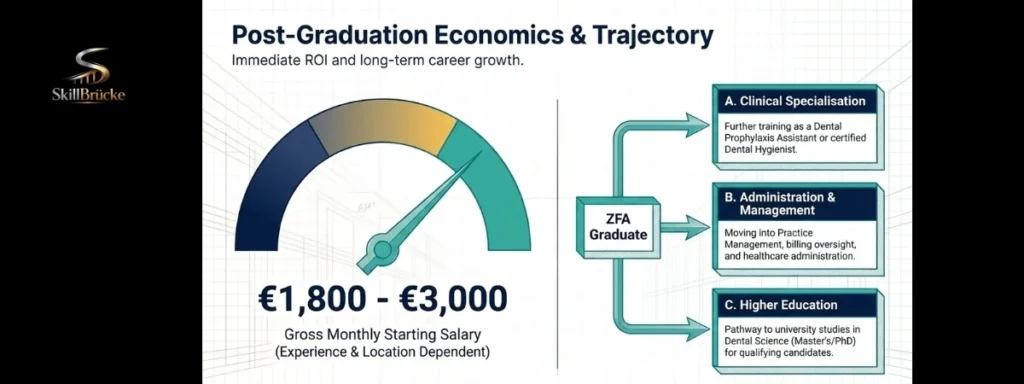
Graduation is merely the launchpad. In Germany’s aging society, the demand for ZFAs is perpetual. The 2026 career landscape offers multiple specialized trajectories for those who demonstrate clinical excellence.
Job Roles After Completion
| Role | Responsibility Level |
| ZFA (Certified) | Core clinic operations and surgical assistance. |
| Dental Hygienist | Specialized preventative care (requires further certification). |
| Practice Manager | Oversight of personnel, finance, and marketing. |
| ZMP/ZMF | Advanced specialized assistants in prophylaxis or surgery. |
Starting and Experienced Salaries
| Professional Level | Gross Monthly Salary |
| Entry Level (Graduate) | €2,200 – €2,800 |
| Specialized Professional | €3,000 – €3,500 |
| Senior Practice Manager | €4,000+ |
A major update for 2026 involves the German Citizenship Act. The residence requirement for naturalization has been reduced to 5 years (and in cases of “special integration achievements,” to 3 years). Since your Ausbildung years count toward this time, a student starting a Dental Assistant Ausbildung in Germany in 2026 could potentially hold a German passport by 2031. This provides a level of socio-economic security that far exceeds the fluctuating dental markets in India, where clinical saturation often leads to underemployment for fresh graduates.
Curriculum for Dental Assistant Ausbildung in Germany
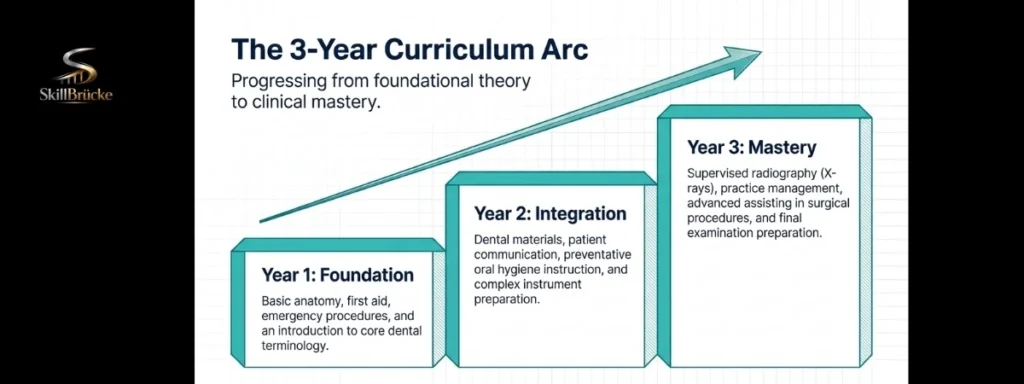
The training curriculum for the Dental Assistant Ausbildung in Germany has undergone a thorough transformation to reflect the technological leaps in modern medicine. The training is organized into structural learning blocks called Lernfelder, designed to take a student from basic clinical orientation to independent operational management.
Year 1: Foundations and Direct Patient Orientation
The first 12 months focus on basic medical science and patient interaction. Trainees learn the anatomy of the oral cavity, tooth morphology, common dental pathologies (such as caries and periodontitis), and initial preventive care. Concurrently, major emphasis is placed on clinical hygiene and the strict infection control protocols governed by the Robert Koch Institute (RKI).
Year 2: Advanced Clinical Assistance and Digital Technology
The second year shifts towards therapeutic procedures and technological deployment. This is where trainees integrate into complex workflows. The curriculum incorporates advanced training in digital dentistry:
- 3D Intraoral Scanning: Moving away from traditional alginate impressions to operating precise optical digital scanners.
- Digital Radiography: Understanding radiation protection (Strahlenschutz) and mastering digital X-ray processing software.
- Material Science: Processing modern composite resins, ceramics, and specialized dental cements.
Year 3: Practice Administration, Economics, and Exam Preparation
The final year prepares the trainee to operate as an administrative lead. It covers the billing structures for both public health insurance (GKV – Gesetzliche Krankenversicherung) and private insurance companies (PKV). Trainees are schooled in practice management software (such as Dampsoft, Charly, or Evident), accounting principles, data protection regulations (GDPR / DSGVO), and error-management systems.
Examination Architecture: The Path to Graduation
To graduate and earn the highly protected title of Zahnmedizinische Fachangestellte, every trainee pursuing a Dental Assistant Ausbildung in Germany must pass two major examinations overseen by the regional Chamber of Dentists.
The Extended Final Examination (Gestreckte Abschlussprüfung)
The examination structure uses a split format designed to test competence progressively throughout your training period:
- Part 1 (Midway Examination): Written typically around the end of the second training year. It evaluates foundational knowledge in clinical hygiene, patient reception, materials management, and basic chairside assistance workflows. It contributes directly to your final graduation score.
- Part 2 (Final Graduation Examination): Conducted at the end of the third year. This part consists of both an extensive written exam and a complex practical simulation.
| Exam Component | Focus Areas & Modules Covered | Assessment Method |
| Written Component 1 | Dental Treatment Assistance (Behandlungsassistenz) & Pharmacology | Single & Multiple-Choice Case Studies |
| Written Component 2 | Practice Management, Patient Billing, and Administration | Open-Ended Applied Scenarios |
| Written Component 3 | Economic and Social Studies (Wirtschafts- und Sozialkunde) | Standardized State Testing |
| Practical Component | Patient Consultation, Emergency Response, and Instrument Preparation | Live Roleplay and Hands-on Clinical Simulation |
If a trainee fails a component of the final exam, German labor law allows them to request an extension of the training contract, permitting them to re-attempt the examination up to two additional times within a specific timeframe.
Top German States and Cities for Dental Opportunities
While opportunities exist nationwide, targeting specific regions can maximize your stipend and career growth.
Top Opportunities by City/State & Key Institutions
| City/State | Strategic Value | Recommended Institutions |
| Frankfurt (Hesse) | Financial hub; high private clinic stipends. | Goethe Dental School, Frankfurt |
| Berlin | International culture; highest ZFA demand. | OSZ Health School, Berlin |
| Munich (Bavaria) | Highest quality of life and peak salaries. | Dachau State Vocational School |
| Hamburg | Maritime hub; excellent specialist clinics. | Heinrich-Hertz-Schule, Hamburg |
| NRW | Most job openings (high population). | Berufskolleg Neandertal |
I recommend NRW or Berlin for Indian students due to the established international communities, which can provide a “soft landing” during the first six months of cultural adaptation.
Conclusion
The Dental Assistant Ausbildung in Germany is more than an educational program; it is a 2026 strategic masterstroke for Indian students. It provides a debt-free pathway to a high-status medical career, immediate financial independence, and a clear, legally secured route to European citizenship. By mastering the German language and respecting the precision of the dual training model, you can transform your life from a student in India to a respected healthcare professional in the heart of Europe.
The demand for your skills in Berlin, Munich, and Frankfurt is at an all-time high. There is no better time to begin your journey. Start your language training today, secure your APS certificate, and take the definitive first step toward your Dental Assistant Ausbildung in Germany.
FAQs
Is there any tuition fee?
Absolutely not. German vocational training is state-funded and employer-paid. You receive money; you do not pay it.
Can I apply if I have no prior dental experience?
Yes. Experience is not required, but a demonstrated passion for healthcare and high manual dexterity are essential for passing the interview.
Is the B1 German language certificate really enough to succeed in the workplace?
While a certified B1 level satisfies the minimum legal threshold to obtain a training visa, it is highly recommended to aim for a B2 level before your official start date. As a dental assistant trainee, you will deal with complex dental terminology, process public health insurance billing codes (GKV), and interact directly with patients in emergency or stressful situations. Most clinics favor candidates with strong B2 communication skills to ensure workplace safety.
Can the 3-year Ausbildung duration be shortened?
Yes, the standard 36-month timeline can be shortened to 2.5 years (or even 2 years in exceptional cases). To qualify for a shortened timeline, you must fulfill specific criteria: holding a higher secondary school diploma (such as the Abitur or Fachabitur), showing outstanding grades at the vocational school, and receiving an official endorsement from your supervising dentist.
What happens if I fail the final Chamber of Dentists (Zahnärztekammer) exam?
If you do not pass either the written or practical sections of the Gestreckte Abschlussprüfung (Extended Final Exam), German labor law protects your position. Your training contract will be legally extended upon your request, allowing you to remain at your clinical practice and retake the failed components during the next state examination window (up to two additional times).
Related Post
Nursing Ausbildung in Germany
Germany Ausbildung Requirements for Indian
Ausbildung Courses in germany