
Through the Ausbildung system, candidates can gain practical work experience, receive monthly remuneration and build a career in fields such as nursing, IT, hospitality, logistics, mechatronics, retail and many others.
However, earning a salary during Ausbildung does not mean that living in Germany is completely free. Before moving, it is important to understand your monthly expenses, accommodation costs, insurance contributions, transportation expenses and the amount of money you may need during the initial settlement period.
Understanding the cost of living during ausbildung in germany is therefore essential for anyone planning to begin vocational training in the country. The amount you need each month depends heavily on your city, accommodation, salary, lifestyle and whether you live alone or share a flat.
Key Highlights: Cost of Living During Ausbildung in Germany
- Monthly living cost: €900–€2,000+
- WG accommodation saves money
- Rent is the biggest expense
- Food costs: €200–€350/month
- Deutschlandticket: €63/month
- Health insurance deducted from salary
- Costs vary by city
- Salary may cover living expenses
- Blocked account may be required
- Budgeting helps save more money
What Is the Average Cost of Living During Ausbildung in Germany?
There is no single fixed monthly amount that applies to every apprentice. A person living in a shared flat in a smaller city may manage with approximately €900–€1,200 per month, while someone renting a private apartment in Munich, Frankfurt or Stuttgart may require €1,500 – €2,000 or more.
A realistic monthly budget may look like this:
| Expense | Shared Accommodation | Living Alone |
| Rent and utilities | €400–€800 | €800–€1,400+ |
| Food and Groceries | €200–€350 | €250–€400 |
| Transport | Around €63 or less with local concessions | Around €63 or less with local concessions |
| Health insurance/social deductions | Usually deducted from salary | Usually deducted from salary |
| Mobile and internet | €20–€50 | €30–€60 |
| Personal expenses | €100–€250 | €150–€300 |
| Leisure and miscellaneous | €50–€200 | €100–€250 |
These are practical planning ranges rather than official fixed figures. Rent is normally the biggest variable. The German Federal Statistical Office reported that prices continued to change in 2026, with overall inflation at 2.3% year-on-year in June 2026 and transport prices rising more strongly than several other categories.
Major Monthly Expenses for Ausbildung Apprentices
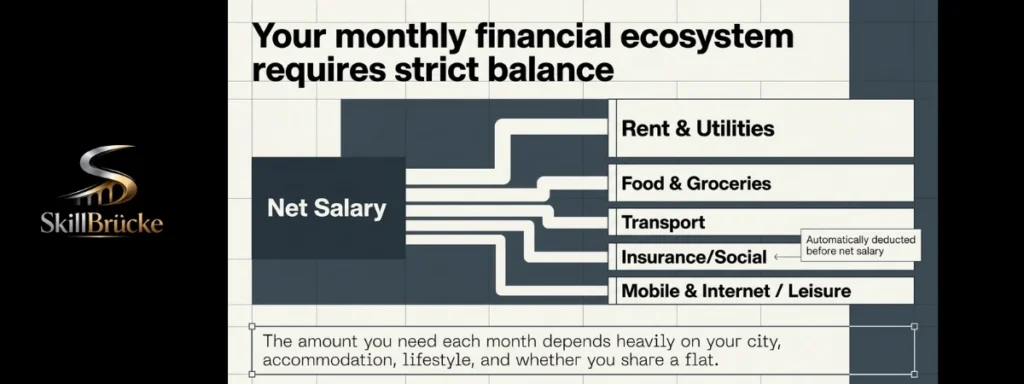
Here are the major Expenses that Ausbildung Apprentices bear:
1. Accommodation and Rent
Accommodation is generally the largest expense for an apprentice in Germany.
The cheapest option is usually a WG (Wohngemeinschaft), which means a shared apartment. You rent a private bedroom while sharing the kitchen and bathroom with other people.
Approximate monthly accommodation costs
| Accommodation Type | Smaller City | Large City | Expensive City |
| Shared room/WG | €300–€600 | €450–€850 | €650–€1,000+ |
| Private room in shared flat | €350–€650 | €500–€900 | €700–€1,100+ |
| Small studio | €500–€850 | €800–€1,300 | €1,100–€1,800+ |
| One-bedroom apartment | €650–€1,000 | €1,000–€1,600 | €1,400–€2,200+ |
A major advantage of living in a WG is that rent, internet and sometimes household expenses are shared. For many international apprentices, this is the most practical way to manage the cost of living during ausbildung in germany during the first year.
Important: Budget for the rental deposit
When renting a property, landlords may require a security deposit known as a Kaution. Under German tenancy rules, the deposit for residential accommodation is generally limited to a maximum of three months’ net cold rent. This can create a significant initial financial requirement.
For example:
- Monthly cold rent: €500
- Maximum deposit: up to €1,500
- First month’s rent: €500
You may therefore need approximately €2,000 or more at the beginning of your tenancy, excluding furniture and other setup expenses.
2. Food and Grocery Expenses
Food expenses depend heavily on your lifestyle.
Someone who regularly cooks at home may spend approximately €200–€300 per month on groceries. A person who eats at restaurants, orders takeaway or purchases ready-made meals frequently may spend €400–€600 or more.
Approximate monthly food budgets
| Lifestyle | Estimated Monthly Cost |
| Very economical, mostly home cooking | €180–€250 |
| Normal grocery shopping and home cooking | €250–€350 |
| Mixed cooking and eating out | €350–€500 |
| Frequent restaurants and takeaway | €500+ |
Cooking at home is one of the easiest ways to reduce monthly expenses. Shopping at budget supermarkets, planning meals and comparing prices can significantly reduce costs.
3. Transportation Costs
Public transport is an essential part of everyday life for many apprentices.
From January 2026, the nationwide Deutschlandticket costs €63 per month. It allows travel on local and regional public transport throughout Germany, although it generally does not cover long-distance ICE, IC or EC trains. Some states and local transport authorities may provide additional discounts for apprentices or other eligible groups.
A typical transportation budget can therefore be:
- Deutschlandticket: €63 per month
- Bicycle: additional one-time or maintenance cost
- Occasional long-distance travel: extra
- Local discounted Azubi ticket: potentially lower, depending on region
If your employer provides a transport subsidy or your local transport authority offers an apprentice discount, your actual monthly transportation expense may be lower.
4. Health Insurance and Social Contributions
Health insurance is compulsory in Germany. For most employees in a dual Ausbildung, health insurance and other social insurance contributions are handled through the German social security system and deducted from the gross remuneration.
The amount you receive in your bank account is therefore your net salary, not your gross salary.
Your deductions may include contributions related to:
- Health insurance
- Pension insurance
- Unemployment insurance
- Long-term care insurance
The exact amount depends on your remuneration, insurance fund, personal circumstances and applicable contribution rules.
5. Mobile Phone and Internet
A basic mobile phone plan may cost approximately €10–€30 per month, depending on data and contract terms.
If internet is not included in your rent, a shared apartment may divide the monthly cost among several residents. Your individual share may therefore be relatively low.
A reasonable monthly budget is:
- Mobile phone: €10–€30
- Internet contribution: €10–€30
- Total: approximately €20–€60
Always check whether internet, heating and electricity are included in your advertised rent. The difference between Kaltmiete and Warmmiete is particularly important.
Cost Differences Between German Cities
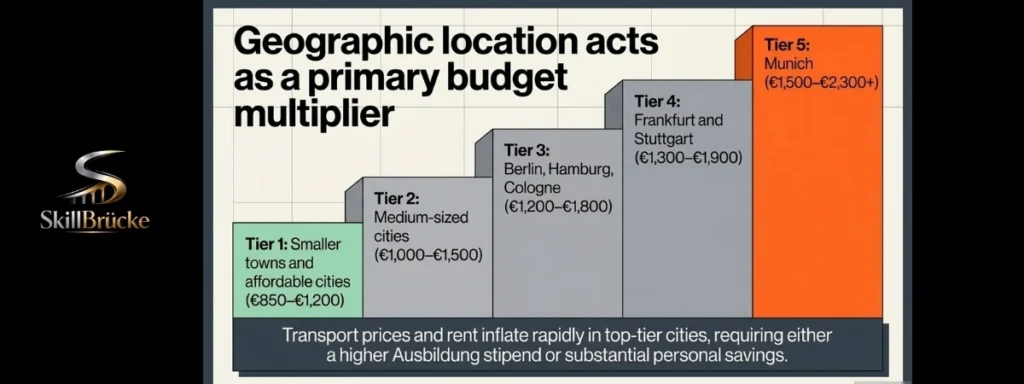
The city you choose can dramatically affect your monthly budget.
Approximate monthly budget by location
| Location Type | Typical Monthly Budget |
| Smaller towns and affordable cities | €850–€1,200 |
| Medium-sized cities | €1,000–€1,500 |
| Berlin, Hamburg, Cologne | €1,200–€1,800 |
| Frankfurt and Stuttgart | €1,300–€1,900 |
| Munich | €1,500–€2,300+ |
These are broad planning estimates, not official city-wide fixed figures.
Is Ausbildung Salary Enough to Cover Living Expenses?
The answer depends primarily on the relationship between your net remuneration and rent.
Scenario 1: Apprentice living in a WG
Suppose an apprentice receives a net income of approximately €900–€1,100.
| Expense | Estimated Amount |
| WG rent and utilities | €500 |
| Food | €250 |
| Transport | €63 |
| Mobile | €20 |
| Personal Expenses | €100 |
| Miscellaneous | €50 |
| Total | €983 |
This type of budget may be manageable, but savings may be limited.
Scenario 2: Apprentice earning more than the minimum
Suppose the net monthly income is approximately €1,300 – €1,600.
With shared accommodation and controlled spending, the apprentice may be able to cover expenses and save a portion of their income.
Scenario 3: Apprentice living alone in Munich
If rent alone reaches €1,200 or more, a lower Ausbildung salary may not be sufficient to comfortably cover all expenses. Additional financial support or a higher remuneration package may be necessary.
Therefore, the cost of living during ausbildung in germany should always be calculated against your actual net salary and not against the gross amount shown in the contract.
Visa Financial Requirements and the Blocked Account (Sperrkonto)
For non-EU/EEA nationals applying for a German vocational training visa under Section 16a of the Residence Act (Aufenthaltsgesetz), proving financial self-sufficiency is a strict visa requirement.
The Federal Benchmark Figure (€992 / Month)
The German Federal Foreign Office uses the national BAföG student financial aid rate as its benchmark for basic living security. For visa applications, the official proof-of-funds requirement is set at €992 per month (or €11,904 per year).
Do Ausbildung Trainees Need a Blocked Account?
Unlike university students who must deposit the full €11,904 into a German Blocked Account (Sperrkonto) prior to arriving in Germany, Ausbildung applicants use their binding training contract as primary proof of financial means.
- Scenario A (Stipend Meets Requirement): If your net monthly Ausbildung stipend is €992 or higher (common in nursing, IT, and specialized industrial trades), you do not need to open a Blocked Account. Your employment contract serves as sufficient proof of financial support.
- Scenario B (Stipend Below Requirement – Partial Blocked Account): If your net monthly stipend is €800, there is a monthly deficit of €192 compared to the €992 official requirement. To bridge this gap for a 12-month visa, you must deposit the shortfall into a partial blocked account:
Required Deposit = (€992–€800) * 12 = €2,304
- Scenario C (Employer Accommodations): If your training employer provides free or heavily subsidized housing/meals, the value of these benefits can be formally deducted from the €992 threshold, reducing or eliminating the need for a blocked account.
Understanding this formula helps ensure your visa application is approved smoothly without requiring unnecessary capital lockups.
10 Ways to Reduce Living Expenses During Ausbildung
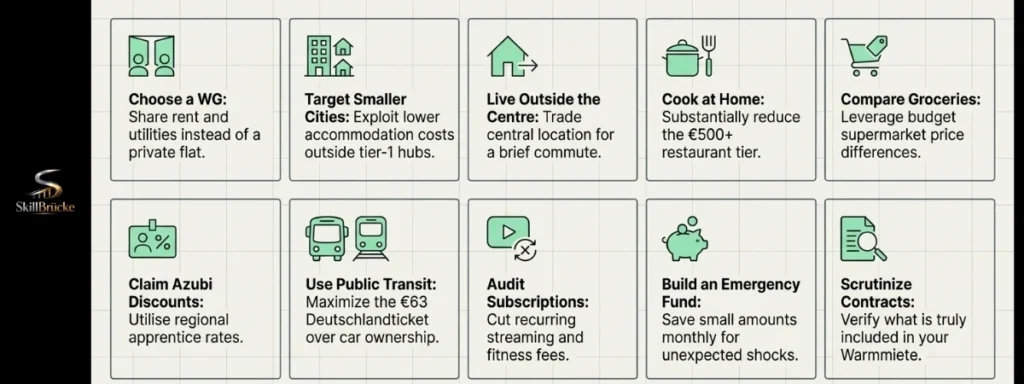
A person with a higher stipend, lower rent or more economical lifestyle may save more. Someone living alone or spending more on restaurants and entertainment may spend significantly more.
- Choose a WG instead of a private apartment
Sharing rent and utilities can reduce monthly expenses significantly.
- Consider smaller cities
A slightly smaller city may offer much lower accommodation costs.
- Live outside the city centre
A location with good public transport may be cheaper than a central neighbourhood.
- Cook at home
Regular cooking can reduce food expenses substantially.
- Compare grocery prices
Different supermarkets can have significant price differences.
- Use apprentice discounts
Some regions and businesses offer special discounts for Azubis.
- Use public transportation
The €63 Deutschlandticket may be cheaper than maintaining a car for many apprentices.
- Avoid unnecessary subscriptions
Streaming, fitness and other recurring subscriptions can quietly increase monthly spending.
- Create an emergency fund
Even a small monthly saving can help with unexpected expenses.
- Read your rental contract carefully
Check what is included in the rent and whether additional charges apply.
Conclusion
Planning your finances before moving to Germany is just as important as finding the right Ausbildung position. In 2026, the legal minimum remuneration for new dual Ausbildung contracts begins at €724 gross per month in the first year, but actual pay varies significantly by occupation, employer and collective agreement.
The cost of living during ausbildung in germany can be manageable when you choose accommodation carefully, control daily expenses and select a city that matches your income. A shared WG, home cooking and public transport can help reduce monthly costs considerably.
FAQs
How much money does an Ausbildung student need per month in Germany?
A realistic budget may range from approximately €900 to €1,800 or more per month, depending mainly on accommodation and city.
Is Ausbildung salary enough to live in Germany?
It can be, especially when living in a WG and earning above the legal minimum. However, lower-paid Ausbildung positions may require additional financial planning.
Is a blocked account required for Ausbildung?
Not automatically in every case. For company-based training, sufficient training remuneration may count as proof of livelihood. If the remuneration is insufficient, additional financial proof may be required.
Does the cost of living remain the same throughout Ausbildung?
No. Your remuneration may increase each year, while rent and other living costs can also change. Your financial situation may therefore improve or become more difficult depending on salary increases and inflation.
Can Ausbildung apprentices save money in Germany?
Yes, but savings depend on the relationship between net income and expenses. A lower rent and controlled lifestyle can make saving more realistic.
Related Post
Germany Ausbildung eligibility
Bakery ausbildung in Germany
Nursing ausbildung in Germany
Vocational training courses in Germany